


Business Sectors
Business Sectors
Events
Contents
Register to read more articles.
Rising demand for green inland pusher tugs and towboats
Towboats and pusher vessels are being built with batteries and prepared to adopt alternative fuels in Europe and the Americas


Demand for efficient cargo transport across continents is rising, as are requirements to reduce emissions and remove bulk from congested roads and railways. This is the backdrop to the latest shipyard orders for low-emissions inland pusher tugs and towboats, and the adoption of energy storage systems on these vessels.
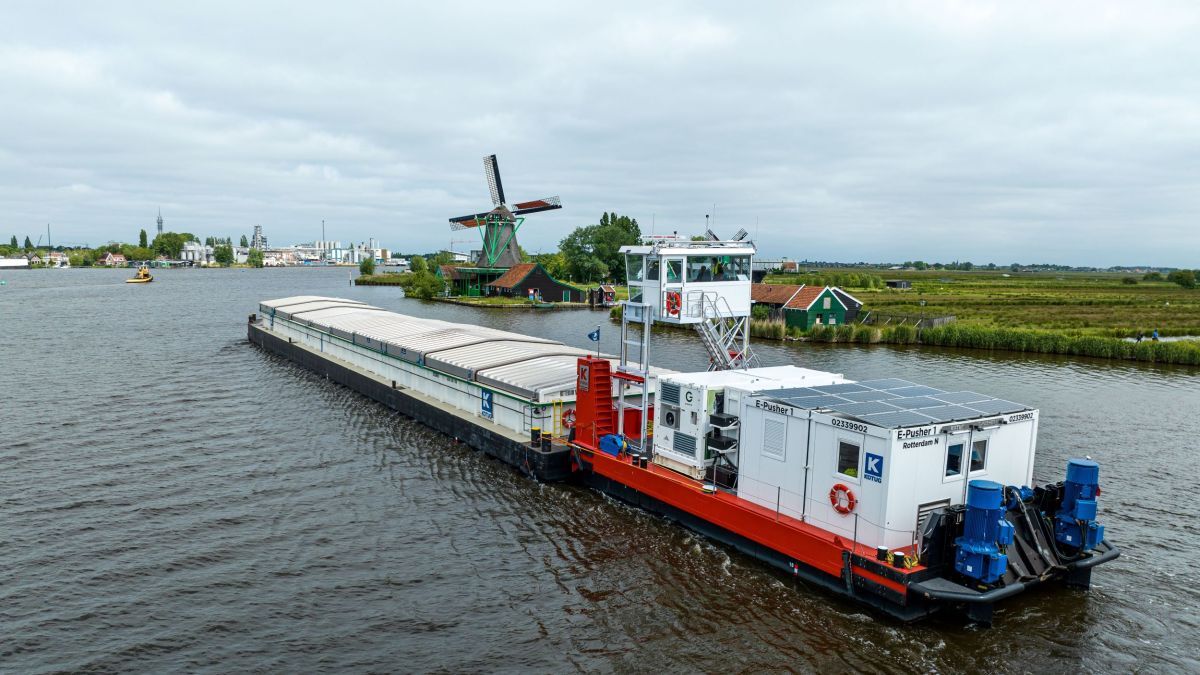
In Europe, Kotug International secured an order for another fully electric pusher tug from Dutch sand transport group ROS. An E-Pusher model M will be constructed to handle and push barges provided by Jansma Shipping for an emissions-free sand transport chain between the Maasvlakte and Rotterdam.
Sand will be loaded on to barges at Maasvlakte and transported to Rotterdam to be unloaded on to electric lorries for onward distribution.
Kotug says its fully electric E-Pusher will be completed in May 2025 and the entire emissions-free system – from transhipment to final delivery – is expected to be fully operational by August 2025.
It will be built at Padmos shipyard, as Kotug has a long-term agreement with the shipbuilder to construct its electric pusher tugs, which come in small, medium and large versions, ranging from 9 m to 22 m in length, with a maximum depth of 0.85 m to 1.35 m.
These vessels will have outboard thrusters on the stern and swappable energy containers, which could carry biogas, hydrogen, batteries or diesel compliant with European Union stage V regulations.
Kotug president and chief executive Ard-Jan Kooren says ROS is creating a “groundbreaking emissions-free transport chain” which demonstrated “sustainable innovation in the maritime industry.” He adds the “E-Pusher is a key part of our strategy to decarbonise inland shipping, and we are excited to partner with ROS and Jansma to make zero-emissions transport a reality in Rotterdam.”
The ROS pusher tug will have a containerised electric power system feeding energy to the outboard thrusters. For the first E-Pusher built in the Netherlands, EST-Floattech supplied its Octopus battery module and Hydromaster Propulsion supplied two 300-kw azimuth electric outboard thrusters.
EST-Floattech worked with Kotug, Sea and Shore and Gebhard Electro to design and customise the Estrin-certified Octopus system with sufficient energy to power the propulsion and auxiliary systems. 2023-built E-Pusher 1 transports cocoa beans for Cargill from the Port of Amsterdam to Zaandam, making up to three return trips on one full charge of the 2-MWh capacity batteries. When at the Cargill facilities in Zaandam, the Octopus container is charged three times per week with energy from renewable sources.
ROS has been transitioning to zero-emissions transport with previous investments in electric cranes for sand handling and a dedicated charging hub for electric lorries installed in Schiedam. The next step will be establishing a 1-MW fast-charging station for the new electric pusher tug for emissions-free inland navigation.
Shell and EST-Floattech unveiled their first 1-MW charger for marine and road transport in June, which Kotug anticipates will be used for charging its E-Pusher series at the Energy Transition Campus Amsterdam (ETCA). This is connected to ETCA’s own micro-electricity grid that includes 3,600 rooftop solar panels, battery storage and a hydrogen electrolyser.
North America
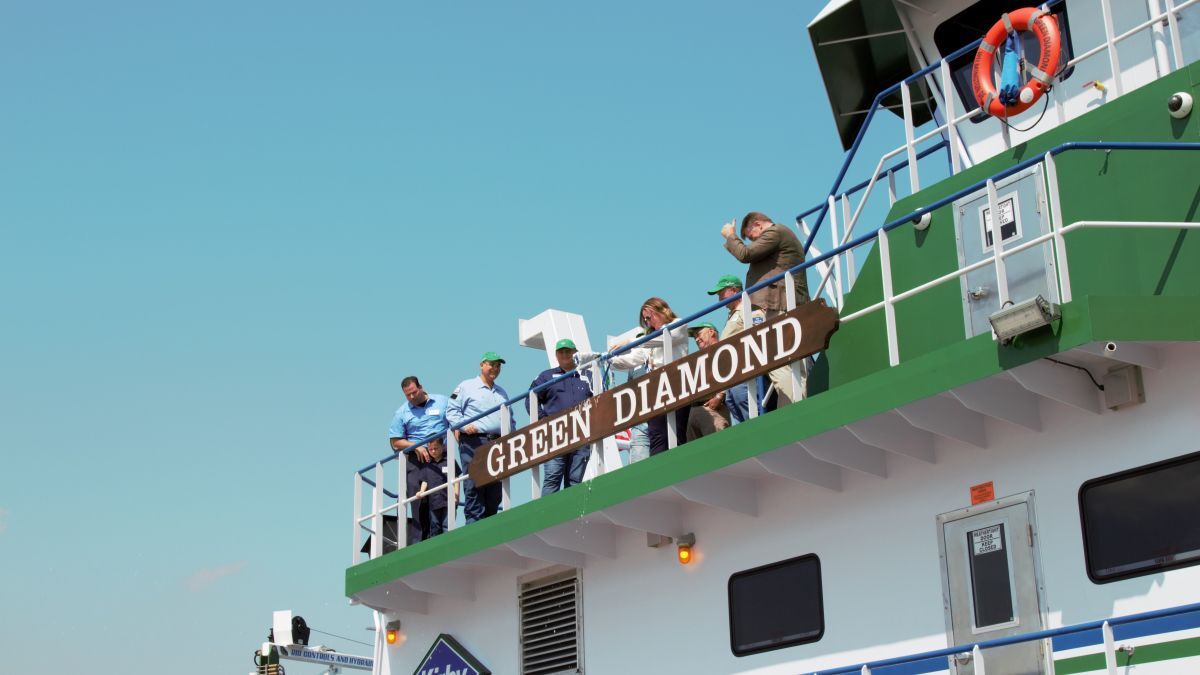
In the US, Shell Trading is operating hybrid-electric towboat, 2023-built Green Diamond, with 1,243 kWh of batteries, chartering it from Kirby Inland Marine to push barges throughout the Houston, Texas port region.
This 22 m by 9 m vessel was constructed by San Jac Marine, Kirby’s shipyard in Channelview, Texas with Caterpillar-manufactured generators and a combined 1,130 kW of power. Batteries and these generators drive two 575-kW Danfoss electric motors, each connected to twin screws.
Shell Energy Solutions is providing electrical power to charge the vessel’s Corvus Orca-series battery system from a plug-in station at Kirby’s Old River Fleet Dock. Kirby subsidiary Stewart & Stevenson Manufacturing Technologies designed and installed the power management, control and propulsion systems.
Maritime Partners is progressing with its plans for the first hydrogen-power towboat, to be named Hydrogen One, in the US after securing a design basis agreement from the US Coast Guard (USCG).
This agreement helps set a framework for the design, arrangement and engineering aspects of the power system and associated safety systems, including the novel technology proposed for generating hydrogen on board to feed into fuel cells to generate power for the vessel.
Maritime Partners anticipates this vessel could push barges from the Port of New Orleans along the Mississippi River and its tributaries at a speed of 6 knots to cover 885 km between refuelling.
Its concept would require a propulsion system capable of generating up to 2,014 kW propulsion power, with 1,268 kW generated by the fuel cell and the remainder from batteries.
Seattle-based Elliott Bay Design Group designed the towboat, Intracoastal Iron Works was selected to build it, and e1 Marine, Rix Industries, Power Cell Group and ABB will provide the onboard power technology, including the hydrogen generator, electrical propulsion, motors, transformers, batteries, fuel cells and local grid.
Market size
But most inland tow and push boats being built will use conventional propulsion with exhaust gas aftertreatment for compliance with US Environmental Protection Agency Tier 4, IMO Tier III or European Union stage V emissions standards.
According to the USCG, 59 towing vessels were listed with 2024 build dates on 30 September 2024. These range from 8 m to 61 m overall length and 500 kW to 5,760 kW vessels. In 2023, 102 towing vessels were built or completed; following 83 built or completed in 2022, 107 in 2021 and 128 in 2020.
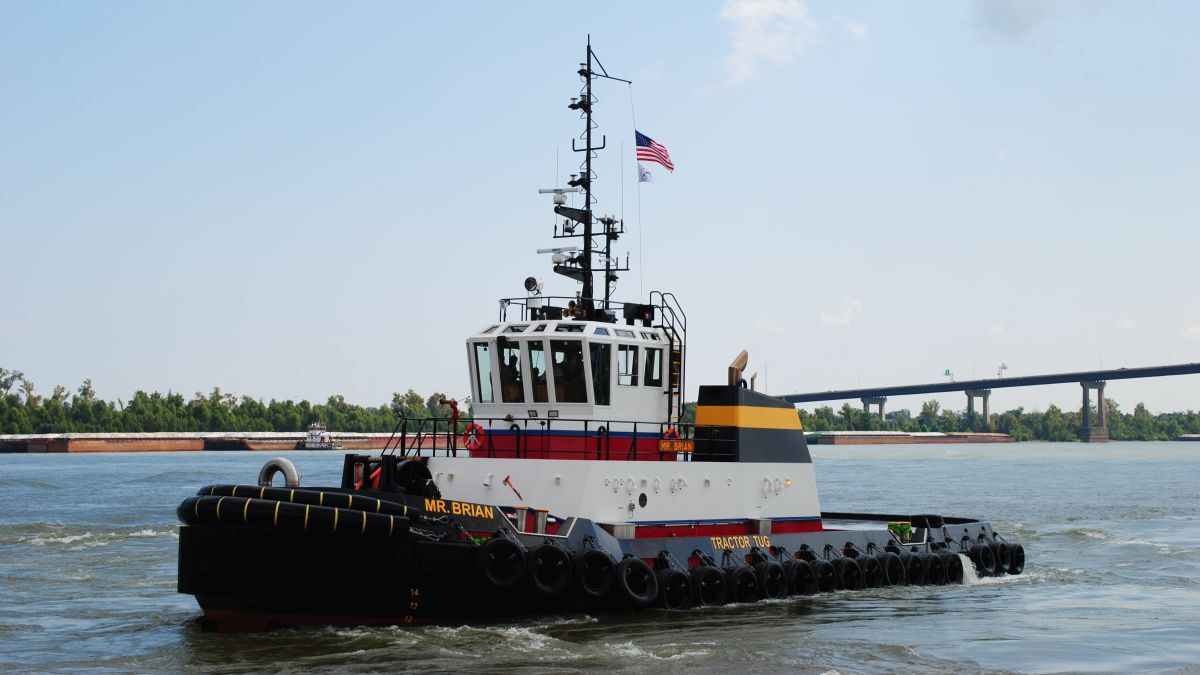
A recent delivery was azimuth stern drive (ASD) tractor tug Mr Brian, built for Bisso Towboat Co by Houma, Louisiana-headquartered Main Iron Works. This is the sixth ASD tractor tug built by the shipyard in the past nine years for the owner.
Its fleet supports ships along the Mississippi River and the owner is the only ship-assist company on the river with a daily operating fleet of 100% ASD tractor tugs.
Mr Brian has an overall length of 31 m, a beam of 12 m, a hull depth of 4 m and a bollard pull of 68 tonnes. This is derived from propulsion consisting of two Caterpillar 3516E main diesel engines generating 1,865 kW each at 1,600 rpm, compliant with US EPA Tier 4, and two Kongsberg US205S Z-drives, each with 2,400 mm diameter four-blade stainless steel propellers in stainless steel nozzles.
Other features include USCG-approved engineroom monitoring and fire/smoke alarm systems, a fixed CO2 fire extinguishing system, Simrad navigation and wheelhouse electronics, soundproof insulation throughout the engineroom and crew quarters, stainless steel bitts and bow staple. Its tanks can store 137,100 litres of diesel, 50,000 litres of potable water, 8,300 litres each of lube and hydraulic oil and 9,100 litres of diesel exhaust fluid.
Newbuilds are also being ordered in South America. Concordia Damen is building a shallow-draught river pusher tug for Uruguayan shipowner Transporte Fluviales Frey Bentos (TFF) to a CDS2410 design in Werkendam, the Netherlands.
This 24-m vessel has around 1,860 kW of power from two Caterpillar C32 engines, generating 930 kW at 1,800 rpm each. TFF will use the pusher to transport
cellulose pulp from Fray Bentos to the port of Nueva Palmira. Sea trials and delivery are expected in Q4 2024.
Sales and newbuilds
In North America, towboat owners are reporting high utilisation and strong demand for their vessels as trade has returned to the high levels seen in 2019 before the Covid-19 pandemic. Charter rates and asset prices have risen, and US shipyards have healthy orderbooks, while delays in obtaining equipment have held deliveries back.
According to shipbrokers Marcon International, this results in owners holding on to assets and a shortage of available towboats for sale.
“Very few owners or operators are looking to sell any of their assets,” say the brokers. “The units which are offered for sale have been at increasingly higher levels. Buyers are being asked to pay a premium for older tonnage, much of which needs overhauls or recertification before being put to work.”
Marcon has identified 23 inland river push boats on the market for sale in June 2024, compared with 29 in mid-2023. Of this, 19 were US flagged and the other four were in Latin America. Two of the boats were built in 2018, but 14 were 45 years old, or older.
None of the push boats offered have power greater than 3,700 kW, reflecting that higher horsepower units are working consistently.
“While we currently have several deals in various phases for tugs and barges, almost all are for ocean and coastal work,” says Marcon. “But even those needs have been hard to fill given the demand for ocean and coastal tonnage is outpacing availability.”
In June 2023, for comparison, 27% of the push boats listed for sale by Marcon were outside the US, with 13% in Europe and 10% in Latin America.
In 2018, however, 83% of the 109 push boats available for sale were in the US, with 10% in Europe and the remainder in the Caribbean, Latin America and Middle East.
A recent transaction was the sale of 6-m pusher vessel Raptor, with two 187-kW Mercury V8 engines for propulsion, by Edward Maritime to Cycle Construction, which was renamed G Cambre.
Other 2024 deals listed by other shipbrokers include:
- Mobile, Alabama-headquartered Cooper Marine and Timberlands Corp acquired 1977-built towboat American Pharaoh from Turn Services and renamed it David J. Cooper Jr.
- Apex Oil sold 1979-built towboat Chandy N to Covington, Kentucky-based Celebration Riverboat, and it was renamed Lucy May. It also sold 1973-built tugboat Dewey R to Ceres Barge Line.
- 2007-built towboat Christiana was sold by Vane Brothers to New York-headquartered Marathon Asset Management and renamed Battery Park. This management company also purchased 2016-built pusher tug Gulf Venture from John Stone Oil, renamed it Prospect Park and chartered it to Maryland-headquartered Vane Brothers.
- Belle Chasse, Louisiana-based Magnolia Tugs has acquired 1980-built towboat Texian from Kirby Corp.
In July, Laborde Marine Management created a new affiliate, LabMar Inland, which will focus on providing towing and push boat services along US inland waterways. This started with 1,490-kW Ivy Steiner chartered in for the service.
“We intend to grow this new facet of our operations with additional towing and pusher vessels, as a natural extension of our many years of serving the offshore market of the Gulf of Mexico,” says New Orleans-headquartered Laborde Marine president Ashton Laborde.
“We have Ivy Steiner, the inhouse expertise, strong management team and skilled crews to quickly build our presence inland. We see increasing demand for our services in the brown water markets of the US, as well as the offshore Gulf of Mexico and look forward to growing in both markets.”
Ivy Steiner, at 220-gt, was built in 2024 by Steiner Construction for its own account and chartered it to LabMar Inland. With an overall length of 24 m, a beam of 10 m and depth of 3 m, it has 1,490 kW of power from two Caterpillar C32 main engines which are compliant with EPA Tier 4 regulations.
Riviera’s TUGTECHNOLOGY ‘25 will be held in Antwerp, 22-23 May 2025. Click here for more information on this industry-leading event.

Related to this Story

Events

Maritime Regulations Webinar Week
 16 Dec 2025
 GMT - ONLINE
Floating energy: successfully unlocking stranded gas using FLNGs and FSRUs
24 Feb 2026GMT - ONLINE
© 2026 Riviera Maritime Media Ltd.


