


Business Sectors
Events

Floating energy: successfully unlocking stranded gas using FLNGs and FSRUs
 24 Feb 2026
 GMT - ONLINE
Contents

NZF delay: what next for IMO’s headline policy?
Shipping associations and policy advisors outline options in the wake of a postponed vote on IMO’s Net-Zero Framework in 2025, warning that politics and fund design still dominates a fractured debate


An expert discussion on the postponed IMO Net-Zero Framework (NZF), panellists said vessel operators have entered 2026 facing regulatory fragmentation risk, uncertain fuel-credit economics and a political process that needs to find its way back to negotiations, rather than a forced binary adoption vote.
Shipping policy advisors and trade body representatives noted that IMO’s decision to adjourn its vote on the NZF had not removed the appetite for a single global outcome, but that progress depended on reframing debate away from an adoption vote and back into substantive negotiation.
ADS Insight partner, Lotten Kronudd, said there remained “a clear willingness to find a workable, global solution” while Intertanko’s deputy director – environment, Emma Scheiris, urged parties to avoid polarised positions and to maintain a focus on a single framework.
"Postponement did not change the implementation of EU rules"
Bimco’s deputy secretary general and directory of regulatory affairs, Lars Robert Pedersen, said restoring a consensus-building dynamic had become the priority ahead of any decision phase. “The most important thing is to get the room back into a negotiation session, rather than a decision session,” he said.
Ms Kronudd said the European Commission’s initial public reaction to the October meeting had softened into a more consultative approach towards EU member states, with Brussels seeking to restore a unified bloc position ahead of the next IMO decision point.
Ms Kronudd said the Commission had reiterated that the postponement did not change the implementation of EU rules, adding: “Until we have a global agreement, the regional framework will stay.”
She said EU discussions had moved quickly compared with the IMO’s meeting cycle and suggested that the politics inside the bloc could now cut both ways: the Commission’s effort to bring dissenting member states back into alignment could also encourage others to seek concessions.
"Returning to an “all-or-nothing” decision environment risked repeating the breakdown"
Ms Kronudd said the Commission had been working on “a single monitoring, reporting and verification framework” intended to cover both the EU ETS and FuelEU Maritime reporting, with proposals expected in Q3 2026, followed by further changes on FuelEU Maritime compliance in 2027.
Ms Scheiris described the October extraordinary session as politically charged and said the adjournment vote had deferred adoption for a year without resolving foundational disagreements.
She said the session had exposed disputes over procedural routes to adoption, governance of the proposed net-zero fund, regulatory fragmentation and the distribution of compliance costs along the value chain.
Ms Scheiris said that, in her view, the industry still wanted “a good, single, global solution”, but that elements of the NZF needed clarification to build consensus.
She said the sustainable fuel certification scheme and life-cycle assessment methodology needed further detail, and that non-fuel energy sources should be recognised alongside alternative fuels.
“All the transitional pathways towards decarbonisation stay open,” she said, citing energy-saving devices, sustainable biofuels, LNG and wind-assisted propulsion as options that operators had been considering.
Mr Pedersen said the NZF that emerged from MEPC 83 in April 2025 had been developed quickly as a compromise package and had not been subject to a dedicated impact assessment before being circulated for adoption at the extraordinary session.
"48% favoured proceeding without US participation, 29% preferred negotiating a bilateral US agreement and 23% supported pausing"
He said the two-tier greenhouse fuel intensity (GFI) design and the accompanying economic mechanics created a complex compliance structure, the practical implications of which were still being tested by the industry.
Mr Pedersen said the politics surrounding the extraordinary session had changed the negotiating climate at IMO.
He said the organisation’s tradition of reaching consensus was under pressure, noting that divisive votes had become more likely and that some states were now using procedural tools that, in his view, departed from established practice: “Votes are very divisive … the normality has changed,” he said.
A particular concern, Mr Pedersen said, was that the committee had reached a point in October where the legal text was effectively in a yes-or-no adoption posture, rather than a space for substantive renegotiation.
He said returning to an “all-or-nothing” decision environment risked repeating the breakdown: “We have to be careful not to get back into that room in a black or white scenario.”
He also highlighted the dispute over whether amendments would follow tacit or explicit acceptance procedures, arguing that a move to explicit acceptance would risk creating a precedent that weakened predictability for future changes.
Mr Pedersen said tacit acceptance had been the standard for amendments for decades and had provided a clear timetable for entry into force, whereas an explicit acceptance threshold would be difficult to meet and could result in amendments never entering into force.
On engagement with the US, there had been strong opposition from the US State Department and the panel was asked whether economic opportunities, including sustainable biofuels, could create a pathway back to negotiations.
Ms Scheiris said it could be worth engaging with the US on “the more economical parts of the proposal”, adding that US production potential for sustainable biofuels and bio LNG was large and could create revenue. “Let’s open that conversation and let’s see what their opinions are,” she said.
Ms Kronudd said Europe needed to adjust its negotiating posture to the current environment, while maintaining the underlying policy goal.
She said Brussels should send an “appropriate delegation” and maintain “a basket of options” in negotiations, while remaining mindful of the EU’s climate policy drivers.
Opinion polls
A series of live audience polls during the expert-led webinar suggested a preference for continued IMO negotiations, alongside a cautious expectation that the framework could be reshaped materially before MEPC 84.
On the preferred pathway ahead, 69% of respondents selected “continue the discussion and try to adopt in one year”, compared with 17% favouring protocol creation and 14% supporting dismissal of the adjourned extraordinary session.
Views on timing skewed towards a longer delay: 57% agreed the delay to the NZF would last three years or more; while 43% disagreed.
Asked what outcome looked most likely at MEPC 84 in April 2026, respondents split between “remove the economic element but keep technical standards” (44%) and “re-establish ES.2 Part 2 with minor adjustments” (42%), with 14% expecting termination and a return to working groups.
On how to respond to US State Department opposition, 48% favoured proceeding without US participation, 29% preferred negotiating a bilateral US agreement and 23% supported pausing until consensus was achieved.
Finally, on whether the EU should proceed with unilateral measures despite IMO delays, 46% supported maintaining a climate leadership position, 31% preferred waiting for global consensus and 23% supported implementation with grace periods to allow alignment.
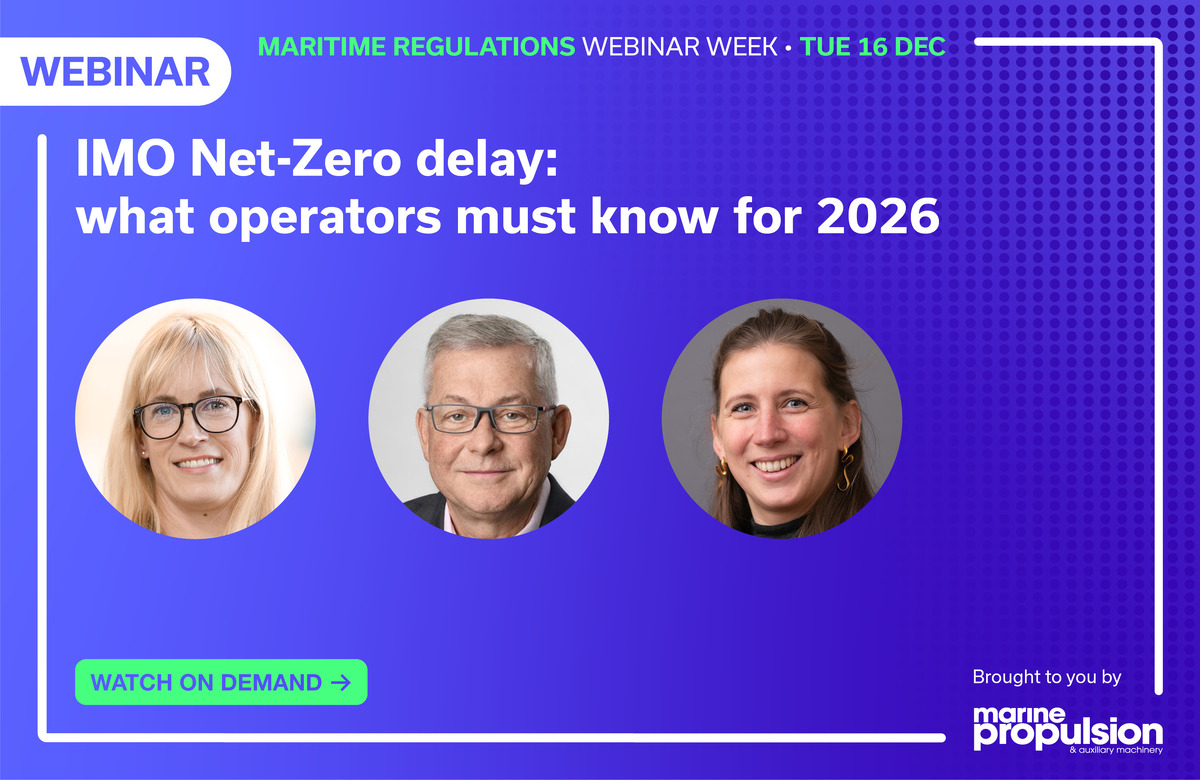
From left to right:
Lotten Kronudd (ADS), Lars Robert Pedersen (BIMCO), Emma Scheiris (Intertanko)
Related to this Story

Events

Maritime Regulations Webinar Week
16 Dec 2025GMT - ONLINEFloating energy: successfully unlocking stranded gas using FLNGs and FSRUs
24 Feb 2026GMT - ONLINE
© 2024 Riviera Maritime Media Ltd.


