


Business Sectors
Business Sectors
Events
Contents
Register to read more articles.

The case for ammonia as a marine fuel
If ammonia is to become a new marine fuel mainstay, it must be adopted in a way that does no harm, meaning low-carbon production using renewable energy and not limiting ammonia’s use in other industries, said WinGD general manager of technical development Andreas Schmid


“We see great potential for ammonia in the marine sector,” Mr Schmid said, at the WinGD-sponsored The case for adopting ammonia in the next five years webinar.
Mr Schmid’s proviso is that ammonia as a fuel must be fully burned in the engine, produced in a sustainable manner and handled with proper safety precautions in place.
What makes ammonia unique among next-generation shipping fuels is that it is likely to only be used as a fuel in the shipping sector, which would insulate its users to a greater degree from price volatility often seen by users of other fuels, such as LNG as a fuel.
Ammonia is a carbon-free molecule that has been safely handled outside of the marine sector for many years as well as having been carried as a marine cargo. Its main use is as a source for fertiliser.
Yara Clean Ammonia (YCA), a company within the Yara Group, is one of the world’s largest producers of fertiliser. YCA director of market development Christian Berg said YCA is a new business unit for green and blue ammonia using technologies that are well established. Ammonia is also well known for its toxicity, but Mr Berg said Yara’s companies have years of experience in safe handling of ammonia.
Global production of ammonia is currently between 100 to 180M tonnes per annum. These levels are expected to rise by 10 to 15M tonnes in coming years, and YCA believes there will be a market for shipowners and charterers.
Offering a shipowner’s view on the use of ammonia as a marine fuel, as an operator of 60 vessels, DFDS has identified green methanol, green hydrogen and green ammonia as the pathways to its goal of becoming climate neutral.
Discussing ammonia’s peers in the decarbonised fuel race, DFDS director Jakob Steffensen said green hydrogen is a favoured route to decarbonisation for many, mainly for short haul shipping, while green methanol has long-range advantages and is compatible with established technology. Mr Steffensen said DFDS has commercial concerns about each fuel option. With green ammonia, the concern is not so much the fuel’s nature or cost, but the rapid growth of competing technologies and the potential for stranded assets.
As a shipowner, investing in new technology on a vessel is a heavy financial commitment, and Mr Steffensen pointed out that 10 years after committing to ammonia, another technology such as fuel cells may have developed to equal or better ammonia’s performance. As a result, many shipowners are considering the option to mix electrical and ammonia power technologies to maintain some flexibility as fuel markets and infrastructure for lower-carbon fuels develop.
Mr Schmid noted there is a danger green ammonia could be confused with other well-to-wake lower carbon fuels due to the adoption of ’green’ as a prefix for a range of new fuels, including hydrogen.
“We need to have a basis for a proper and fair discussion based on facts and not feelings,” he said.
Mr Berg said fuel availability was key to adopting ammonia.
“Ammonia will be available [as a marine fuel], and we are going to do everything we can to make it available as a future fuel. That is why we are involved in developing the bunker terminals and the technology,” he said.
Mr Steffensen noted having rules in place will provide the mechanisms and frameworks to build ammonia-fuel-compliant vessels.

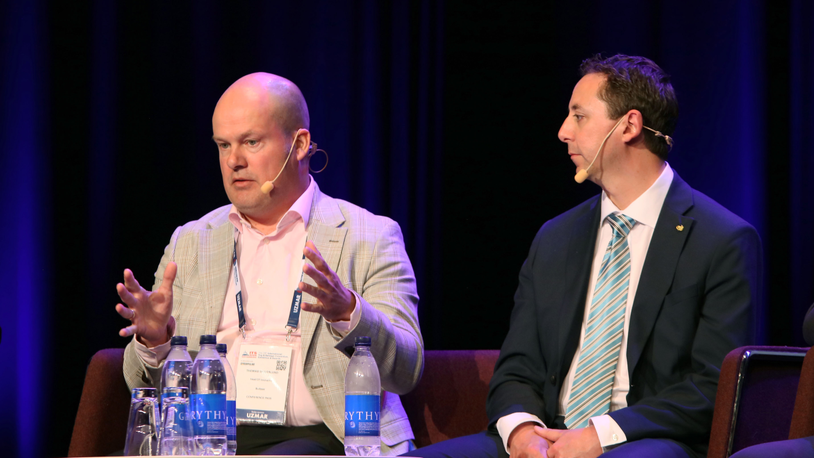
From left to right: WinGD general manager technical development Andreas Schmid, DFDS director Jakob Steffensen and Yara Clean Ammonia director of market development Christian Berg

Related to this Story


Events

Maritime Regulations Webinar Week
 16 Dec 2025
 GMT - ONLINE
Floating energy: successfully unlocking stranded gas using FLNGs and FSRUs
24 Feb 2026GMT - ONLINE
© 2026 Riviera Maritime Media Ltd.


