


Business Sectors
Business Sectors
Events
Contents
Trump claims immediate US blockade of Strait of Hormuz in social media post
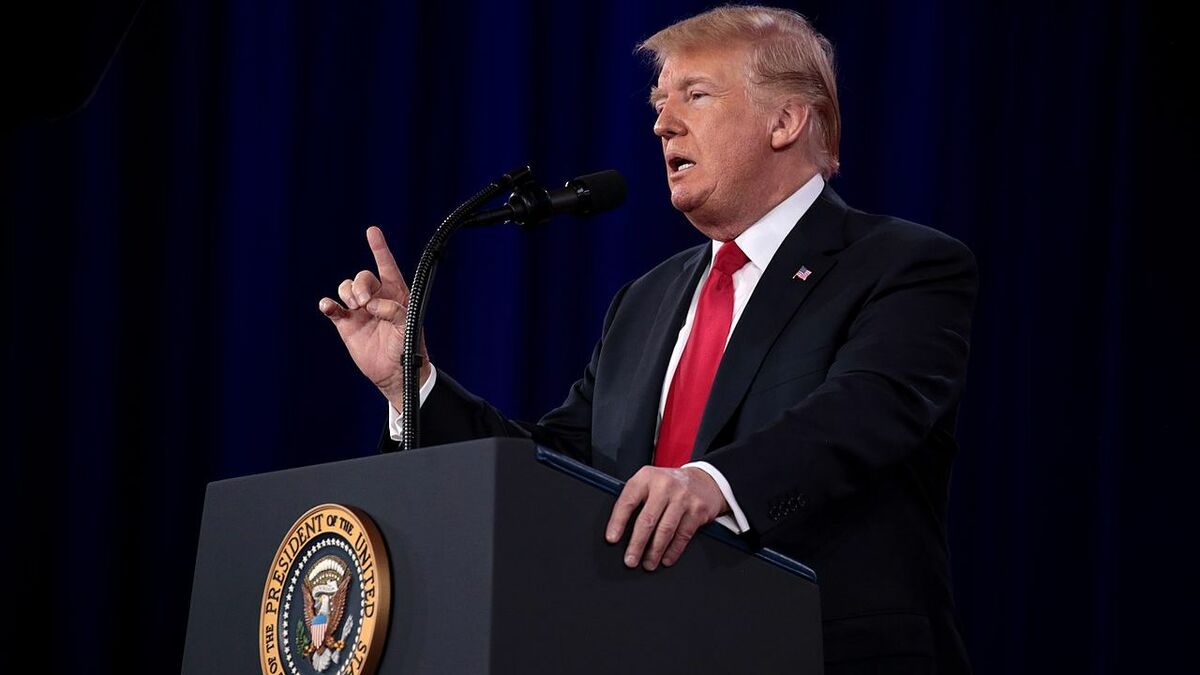
US President says forthcoming blockade will apply to ’any and all ships trying to enter or leave the Strait of Hormuz’


US President Donald Trump has again taken to the social media platform he owns to announce military action by the US. Among other military action and economic policy, Mr Trump has announced tariffs via Truth Social, including port fees on commercial shipping vessels, a US$20Bn maritime reinsurance plan and military escorts through the Strait of Hormuz.
Writing on Truth Social, the US President said that, while bilateral negotiations between the US and Iran mediated by Pakistan in its capital, Islamabad, had gone "well", and "most points were agreed to", that areas of disagreement remained.
The outcome, he said, meant that US Navy forces would begin operations to blockade the Strait of Hormuz.
"Effective immediately, the United States Navy, the Finest in the World, will begin the process of BLOCKADING any and all Ships trying to enter, or leave, the Strait of Hormuz. At some point, we will reach an “ALL BEING ALLOWED TO GO IN, ALL BEING ALLOWED TO GO OUT” basis," the social media post said.
Mr Trump blamed Iran for the action, claiming that Iranian threats of naval mines in the Strait of Hormuz amounted to global ’extortion’.
The US President said that the US Navy would also begin interdicting vessels that had paid tolls to Iran for safe passage of the Strait.
"I have also instructed our Navy to seek and interdict every vessel in International Waters that has paid a toll to Iran. No one who pays an illegal toll will have safe passage on the high seas," Mr Trump wrote, while threatening that "Any Iranian who fires at us, or at peaceful vessels, will be BLOWN TO HELL!"
Iran’s Islamic Revolutionary Guards Corps (IRGC) has consolidated almost total control over the Strait of Hormuz since the US and Israel began bombing Iran on 28 February 2026. Iran has reportedly charged tolls to vessels for transiting the Strait of Hormuz, and a toll regime is part of a 10-point plan that the US President had called ’workable’ in social media posts published in the lead-up to negotiations in Pakistan.
Iran’s 10-point plan, published by Iranian state-controlled media outlets, also includes lifting sanctions, Iran’s continued control, via a ’safe-transit protocol’, of the Strait of Hormuz, US military withdrawal from the Middle East and a binding United Nations Security Council resolution, among other things.
In his latest posts on Truth Social, the US President also threatened future military action against Iran, saying that the US is "LOCKED AND LOADED, and our military will finish up the little that is left of Iran".
Mr Trump linked his tirade of threats to both Iran’s unwillingness to agree to discontinue its ambitions to build nuclear weapons and what the US President called Iran’s failure to keep what he called a promise to open the Strait of Hormuz.
"This caused anxiety, dislocation, and pain to many people and Countries throughout the World," according to Mr Trump’s post.
Negotiations’ end leaves ceasefire uncertain
Diplomatic negotiations in Pakistan ended without a deal, but a temporary, conditional and patchily observed ceasefire period appears to still be in place. That is set to expire on 22 April. Pakistan reportedly urged all parties to maintain the fragile ceasefire deal as US negotiators, including US Vice President JD Vance, US Special Envoy Steve Witkoff and Donald Trump’s son-in-law Jared Kushner, departed from Pakistan without a clear end to the fighting.
"The meeting with Iran began early in the morning, and lasted throughout the night – Close to 20 hours. I could go into great detail and talk about much that has been gotten, but there is only one thing that matters – IRAN IS UNWILLING TO GIVE UP ITS NUCLEAR AMBITIONS! In many ways, the points that were agreed to are better than us continuing our Military Operations to conclusion, but all of those points don’t matter compared to allowing Nuclear Power to be in the hands of such volatile, difficult, unpredictable people," Mr Trump wrote.
It remains unclear when the naval blockade and interdiction policy announced by the US President will begin and what effect the military enforcement of either will have on the ceasefire.
The fragile truce between Iran and the US and Israel quickly gave way to attacks and recriminations, with a deadly Israeli bombing campaign in Lebanon and Iran keeping tight control on ship traffic in the Strait of Hormuz.
The IRGC has halted vessels in the Strait, according to Iran’s semi-official Tasnim news agency, and Iran’s state-backed media outlet Islamic Republic of Iran Broadcasting (IRIB) released information from Iran’s Ports and Maritime Organization that included a map detailing both a traffic separation scheme and the threat of naval mines.
"Due to the war situation in the Persian Gulf and possible anti‑ship mines in the main traffic zone of the Strait of Hormuz, vessels must co-ordinate with the IRGC Navy and use the designated routes," IRIB quoted Iran’s Ports and Maritime Organization as saying.
No attacks on commercial vessels have been reported in the Strait of Hormuz since the ceasefire deal was announced, according to the Royal Navy-operated United Kingdom Maritime Trade Operations Centre.
Vessel traffic through Strait of Hormuz ’unchanged’, say analysts
With the status of the ceasefire still in question, very few vessels are attempting a transit, with most transiting out of the Persian Gulf originating from Iran.
France-based commodities data tracker AXS Marine said it tracked four vessels crossing the Strait of Hormuz inbound on 8 April. Two container vessels (both under 3,000 TEU) and two bulk carriers (above 50,000 dwt) arrived in ballast to load at Bandar Abbas. All four vessels were Iranian-owned, according to AXS Marine.
Seven vessels transited the Strait outbound between 8 April and early on 9 April, AXS said, with five being bulk carriers. In addition, AXS tracked the transits of a small, Omani-owned feeder vessel and a 46,000-dwt chemical/product tanker.
The tanker "crossed under full AIS blackout" and was under "opaque ownership", according to AXS.
"Transit behaviour remains highly irregular: blank or manipulated AIS transmissions, non-standard cargo declarations mid-transit, continued use of AIS blackout by certain vessels, routeing via Larak Island," AXS said in a post on X (formerly Twitter).
"The nine crossings recorded on 8 April alone do not signal normalisation. Reports also indicate vessels being turned back, while the ceasefire itself has already seen multiple violations."
Sign up for Riviera’s series of technical and operational webinars and conferences:
- Register to attend by visiting our events page.
- Watch recordings from all of our webinars in the webinar library.


Related to this Story


Events

Maritime Regulations Webinar Week
 16 Dec 2025
 GMT - ONLINE
Floating energy: successfully unlocking stranded gas using FLNGs and FSRUs
24 Feb 2026GMT - ONLINE
© 2026 Riviera Maritime Media Ltd.


