


Business Sectors
Business Sectors
Events
Contents
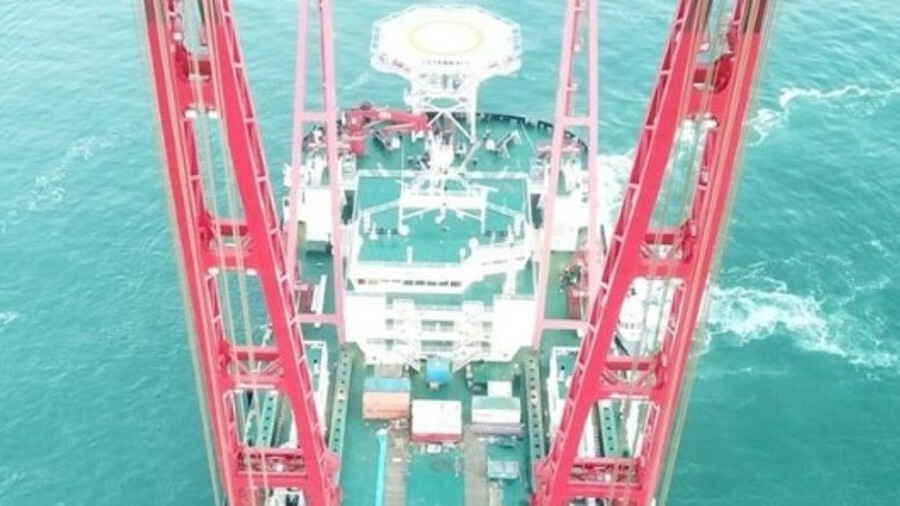
Crane vessel Gulliver can travel under its own steam


The fully self-propelled DP2 crane vessel Gulliver was delivered to marine heavy-lift firm Scaldis by Dutch shipbuilder Royal IHC on 20 April.
Gulliver has a lifting capacity of 4,000 tonnes, a maximum lifting height of 78.5 m above deck and a transit speed of 7 knots. It is 108 m long, with a moulded breadth and depth of 49 m and 8 m, respectively. The crane vessel has a helideck and provides accommodation for 78 people. Gulliver has 11,420 dwt.
Scaldis will primarily use the ship for deepwater oil and gas sector purposes, such as offshore infrastructure installation and decommissioning, and the installation of offshore windfarms.
It can also be used for other tasks, such as clearing shipwrecks and subsea obstacles and the construction of bridge components.
The design for the vessel was drawn up inhouse in co-operation with Vuyk Engineering Rotterdam. Royal IHC managed the design, procurement, construction and commissioning. Gulliver was built in China then moved to ROG Rotterdam to finalise commissioning activities and acceptance tests. Following successful sea trials and a 4,000-tonne load test, the vessel is now fully operational.
The delivery brings Scaldis’ Belgium-flagged, twin-craned fleet up to two vessels, joining non-self-propelled crane pontoon Rambiz, which has a lifting capacity of 3,300 tonnes.
As well as being capable of moving under its own steam, Gulliver improves on Rambiz’ capabilities by offering increased lifting capacity and height, enlarged deck space and skidding cranes, allowing greater flexibility.
Antwerp-headquartered Scaldis is jointly owned by Dutch firm DEME and Belgian companies Herbosch-Kiere and Jan de Nul, all three of which are marine engineering and dredging firms.
Royal IHC was established in 1965 via the merging of six Dutch shipyards and specialises in equipment, vessels and services for the offshore, dredging and wet mining markets.


Related to this Story

Events

© 2026 Riviera Maritime Media Ltd.


