


Business Sectors
Business Sectors
Events
Contents
Register to read more articles.
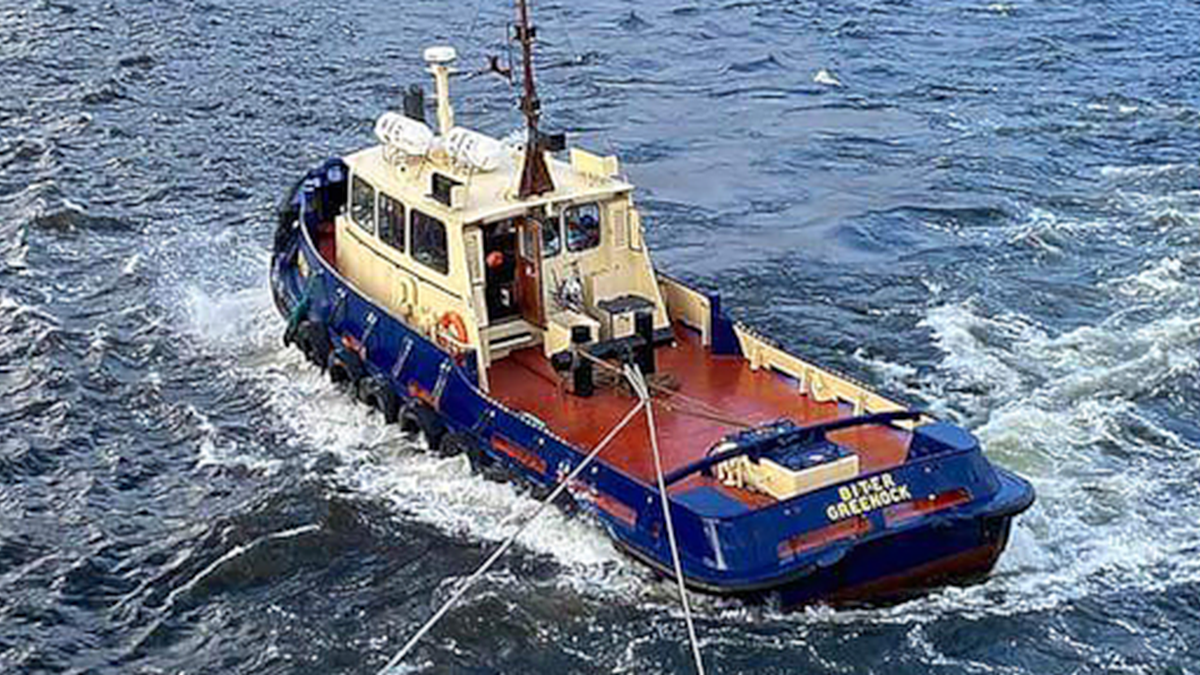
Accident report: lack of training causes fatal tug capsize
A report into a Scottish tugboat’s capsize and sinking identified several safety issues in towage operations and pilot-master interactions on the river Clyde


Maritime pilots need better training in operating various types of tugboats and to understand their limitations and vulnerabilities to prevent future fatal accidents.
This was one of the key messages from the UK Government’s Marine Accident Investigation Branch’s (MAIB) report into the deadly capsizing of a harbour tug in Scotland in Q1 2023.
Other recommendations to the wider maritime and ports sectors were to share detailed towage plans, improve risk assessment, gain better understanding of how speed impacts towing forces, and keep hatches closed to maintain watertight integrity.
The MAIB investigated the sudden and fatal capsize and sinking of the tug Biter, with the loss of two lives, off Greenock, Scotland on 24 February 2023. This twin-screw conventional tug girted and capsized while attached to the stern of passenger vessel Hebridean Princess, which was making its approach to James Watt Dock. Biter’s two crew were unable to escape from the capsized vessel and died in the cold river Clyde waters.
“Tug Biter’s accident was another cruel lesson of how rapidly things can go dreadfully wrong,” said the UK government’s chief inspector of marine accidents, Andrew Moll.
“In less than 10 seconds the tug capsized, and two experienced seafarers lost their lives, because of a breakdown of the systems that should have kept them safe.”
Several safety issues were identified by the MAIB during its accident investigation, including how the marine pilot’s training had not prepared them to work with conventional tugs.
Ship master-pilot and pilot-tug exchanges were incomplete and there was no shared understanding of the towage and ship manoeuvring plan, the MAIB discovered.
Also, the passenger vessel’s master and the tug masters were unable to challenge the pilot’s intentions.
The MAIB said, “The passenger vessel’s speed placed a significant load on the tug’s lines and almost certainly caused the gob rope to render. The tug’s gob rope did not prevent it being girted and the tug’s rapid capsize meant the crew had insufficient time to release its towlines.”
Investigators also found an open hatch compromised the tug’s watertight integrity and limited the crew’s chance of survival.
“Small conventional tugs remain an essential part of UK port operations. However, the vulnerabilities of these vessels must be understood by those that operate and control them,” said Mr Moll.
“Harbour authorities, ship and tug masters, and pilots should collectively own this risk. Pilots and tug crews must be suitably trained and experienced for their roles, and they must share a detailed understanding of the towage plan before they start the job.”
Investigators found the ferry’s approach to James Watt Dock was too fast for the tug’s abilities and stability.
“Speed, which has an exponential effect on towing forces, must be carefully controlled and the lines correctly set,” said Mr Moll. “Everyone involved must then monitor the execution of the plan and, if needed, act to keep everyone safe.”
Recommendations (2024/157 to 2024/166) were made by the MAIB to Biter’s owner, Clyde Marine Services, to review its safety management system and risk assessments to provide clear guidance on the rigging of the gob rope; the safe speed to conduct key manoeuvres; and to adopt a recognised training scheme for its tug masters.
The investigation branch also made recommendations to Clydeport Operations to commission an independent review of its marine pilot training and to risk assess and review its pilot grade limits and tug matrix.
Recommendations were made to professional associations representing pilots, harbour masters and tug owners to develop appropriate guidance on the safety issues raised in this report.

Related to this Story

Events

Maritime Regulations Webinar Week
 16 Dec 2025
 GMT - ONLINE
Floating energy: successfully unlocking stranded gas using FLNGs and FSRUs
24 Feb 2026GMT - ONLINE
© 2026 Riviera Maritime Media Ltd.


