


Business Sectors
Business Sectors
Events
Contents
Register to read more articles.
Data-driven maritime innovations shape operations
AI and advanced connectivity are transforming maritime operations, fostering data-driven decisions and enhancing efficiency in a complex shipping landscape


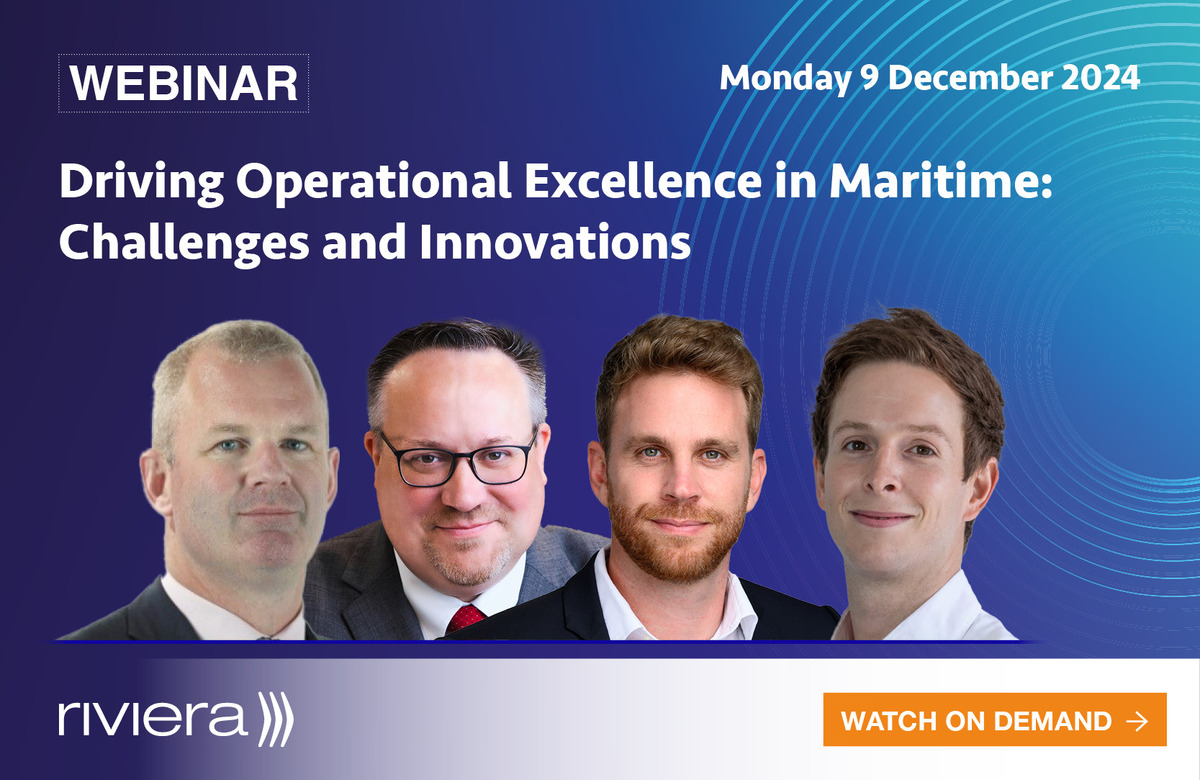
Advancements in artificial intelligence (AI) and digital connectivity are reshaping maritime operations, a panel of experts outlined during a webinar hosted by Riviera Maritime Media.
Sponsored by Orca AI and DeepSea AI, the discussion delved into how data-driven insights and technology adoption are enabling shipping companies to improve operational efficiency, safety and environmental performance.
Orca AI chief executive Yarden Gross noted the transformative impact of connectivity on shipping, “The integration of cloud technology with onboard systems allows us to collect and analyse vast amounts of data, training AI models to enhance operations and empower crews with actionable insights,” he explained.
Mr Gross also highlighted the increasing openness of younger crews to technological solutions, noting, “The generational shift is paving the way for faster adoption of digital tools.”
DeepSea AI president Roberto Coustas underscored the importance of real-time data in optimising vessel performance, “Currently, many shipping companies rely on outdated noon reports, creating a 15% margin of error in fuel consumption predictions,” he said.
Mr Coustas argued AI could close this gap by integrating weather conditions, hull fouling states and other variables into accurate, actionable performance models.
“You cannot improve what you cannot measure,” he remarked, noting the ROI potential of data-driven decisions.
The discussion also addressed the challenges posed by regulatory pressures and alternative fuel adoption.
“Navigating the transition to greener fuels is expensive and uncertain,” Mr Coustas explained, “AI helps reduce these costs by enabling more precise operational planning.”
Scorpio Group chief operating officer Cameron Mackey brought attention to the human factors involved in technology adoption and stressed while AI can reduce workloads, the industry must manage the transition carefully to avoid overloading crews, “We do not see a skills gap; we see a time gap. Our focus is on aligning priorities to ensure new tools enhance, rather than complicate, operational workflows,” he said.
The webinar concluded with reflections on the long-term potential of AI in enabling autonomous operations.
Mr Gross shared insights from Orca AI’s work with Japanese shipping companies on remote control and autonomous voyages, while Mr Coustas highlighted DeepSea’s efforts to combine naval engineering with AI for holistic optimisation.
ABS chief technology officer Patrick Ryan noted advanced data analytics are already reducing drydock days for clients, a tangible step toward maximising fleet availability.
With AI models becoming increasingly robust and user-friendly, the consensus among the panellists was clear: technology is not replacing human expertise but augmenting it.
As Mr Mackey succinctly put it, “The goal is to make individuals more effective, not just more efficient.”
This chimed with the results of the Riviera poll that took place during the webinar, revealing lowering operational costs emerged as the leading expectation from autonomous capabilities (41%), followed by minimising crew workload (34%), underscoring the industry’s drive toward efficiency.
When considering safety priorities for 2025, over half of respondents (54%) stressed identifying high-risk trends for proactive action, signalling a focus on predictive measures.
Automation dominated crew management priorities, with 65% favouring daily task automation to reduce workloads.
Advanced inhouse analysis was the most prevalent vessel performance monitoring capability (45%), reflecting the industry’s growing reliance on proprietary systems.
In performance areas, advanced analytics were seen as most beneficial for improving fuel efficiency (40%), further emphasising cost control and environmental goals.
Regarding high-frequency sensor data adoption, 33% reported more than 75% of their fleet was equipped, though a significant 27% indicated less than 10%, showcasing a wide disparity in technological integration across fleets.
These results illustrate the industry’s focus on leveraging technology to streamline operations, enhance safety and meet sustainability goals.
Sign up for Riviera’s series of technical and operational webinars and conferences:
- Register to attend by visiting our events page.
- Watch recordings from all of our webinars in the webinar library.


Related to this Story


Events

Maritime Regulations Webinar Week
 16 Dec 2025
 GMT - ONLINE
Floating energy: successfully unlocking stranded gas using FLNGs and FSRUs
24 Feb 2026GMT - ONLINE
© 2026 Riviera Maritime Media Ltd.


