


Business Sectors
Business Sectors
Events
Contents
Register to read more articles.
Getting ready for prime time: high-speed methanol engine options
Recent approvals in principle clear the way for field tests of new four-stroke methanol engines and retrofits


Two-stroke dual-fuel, slow-speed marine engines capable of operating on methanol have been available for a decade, racking up more than 600,000 running hours. This success has proven the viability of this low-carbon, alcohol-based fuel for use in the sector, with more options now commercially available from medium-speed OEMs.
But the first four-stroke, high-speed engines to burn methanol are just beginning to be introduced. With approvals from class societies in hand, engine designers plan to conduct extensive field tests of demonstrator models with the idea of making four-stroke methanol dual-fuel engines commercially available in the next three years.
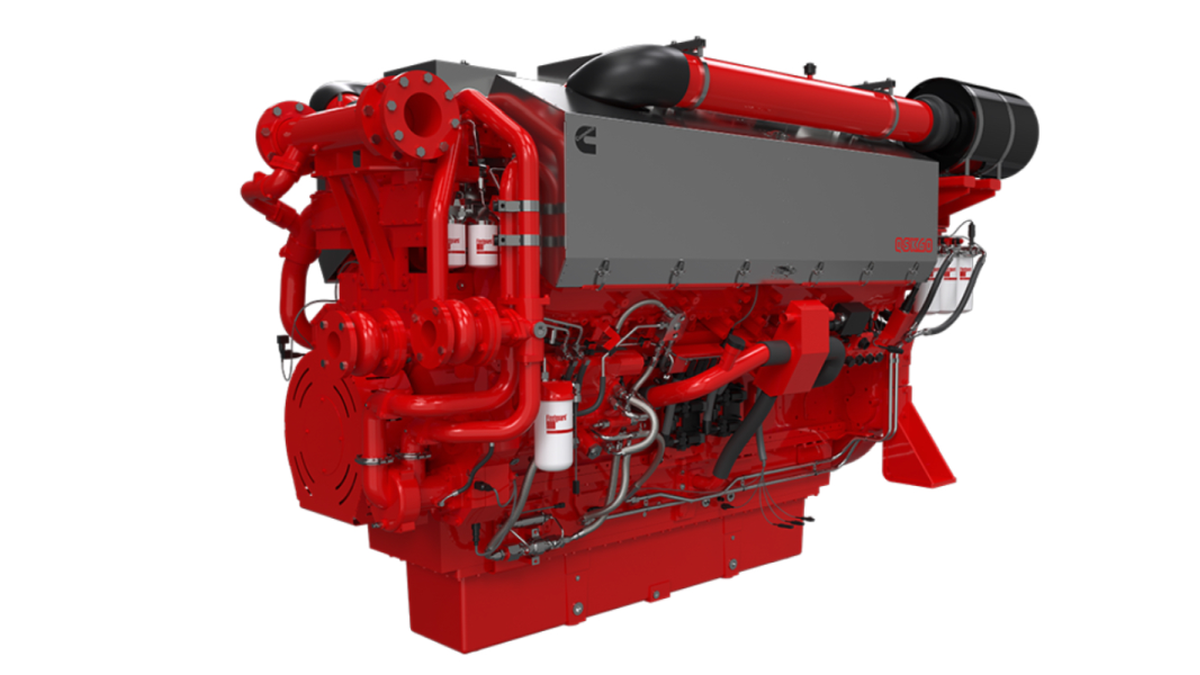
One of those engine builders is Cummins. Dawn Wehr, executive director for strategy, product planning and digital for the Columbus, Indiana, OEM, says the company is “committed to providing solutions that work for different operations and fuel infrastructure availabilities to ensure ease of adoption.”
DNV awarded an approval in principle (AiP) to Cummins for its methanol-ready QSK60 IMO II and IMO III engines in June 2024. Designed with modular common-rail systems, these high-speed four-strokes are available in power ratings between 1,491 - 2,013 kW at speeds of 1,600-1,900 rpm.
Following field tests, Cummins plans to launch its methanol retrofit kit post 2028 “to align with market demand and infrastructure readiness.”
This project focusses on the conversion of existing engine installations, offering a simpler transition to burning zero- and low-carbon alternative fuels.
“There is a huge environmental benefit doing this”
Using green methanol, produced with renewable energy, offers significant environmental benefits compared to traditional marine fuels. It can reduce CO2 by 60-95% and NOx emissions by 60-80%, and virtually eliminate sulphur oxide and particulate matter emissions, according to the Methanol Institute.
Most of the currently available methanol is produced through steam reformation using natural gas as a feedstock. This fossil-based, grey version of the fuel is widely traded and used as a chemical component in solvents, plastics, paints and other products.
With an eye on futureproofing, Cummins says these new retrofit kits are designed for diesel-electric systems, and integration with battery technology. Battery-hybrid applications continue to grow, particularly in the offshore oil and gas and renewables sectors to improve efficiency, lower maintenance and cut CO2 and greenhouse gas (GHG) emissions.
Bibby Marine, for example, has ambitions to operate its new all-electric commissioning support operations vessel (eCSOV) entirely on batteries charged by renewable energy from offshore or shore-charging infrastructure to attain zero emissions when it is delivered in 2027. But the UK offshore vessel owner designed the eCSOV with operational flexibility to be powered by electrons or molecules. The 90-m vessel has 25 MWh of Corvus Blue Whale ESS, and two four-stroke Wärtsilä 3.48-MW W32 methanol dual-fuel engines.
Bibby Marine newbuild project manager, Gavin Forward, tells us that funding from the UK government allowed the owner to “put this big battery pack and a methanol fuel system [in place] to ensure that we can stay competitive with others delivering standard MDO vessels.”
Another consideration in the vessel’s design says Mr Forward are forthcoming taxes on carbon emissions resulting from regional regulations, the EU Emissions Trading System and FuelEU Maritime.
“We look at the taxes coming in for the carbon and they are going to be around about US$100 to US$300 per ton. There are three tons of CO2 produced per ton of fuel consumed. So that’s a huge cost,” he said.
Mr Forward anticipates running on power generated from the grid will be far less expensive. “Even if you take a relatively high price for the power off the wind turbine, we are still looking at saving around about a third of the cost per day on operating costs, or a fifth of the cost when we consider the taxes as well,” he states. “Additionally, there is a huge environmental benefit doing this,” he adds.
In announcing the contract to supply its Blue Whale ESS, Corvus said that unlike conventional hybrid propulsion systems, the eCSOV will use its battery system as its primary power source, with engines running “solely for charging”. This, Corvus said, offers a constant, optimised load to improve efficiency and extend battery life.
Meanwhile, Ms Wehr says one advantage of Cummins’ retrofit kit is that it “dismisses the need for a major vessel overhaul and creates an immediate positive impact on carbon-emissions reduction.”
She notes Cummins R&D on alcohol-based fuels is part of its commitment “to providing solutions that work for different operations and fuel infrastructure availabilities to ensure ease of adoption.”
This ease of adoption extends to drop-in fuels. In August 2023, the engine manufacturer
approved the use of hydrotreated vegetable oil (HVO) across its high-horsepower engine range. Using HVO — renewable diesel — allows vessel owners to reduce GHG emissions by as much as 90% compared to diesel without changing engine technology, says Cummins.
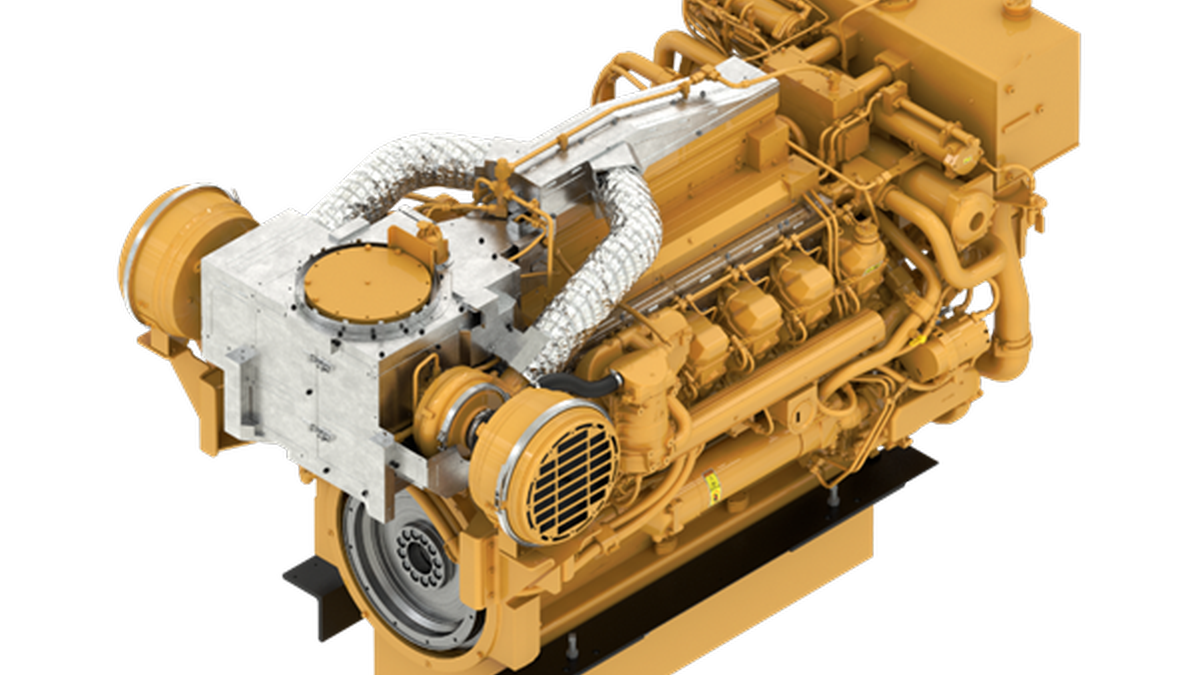
DNV has also issued an AiP to Caterpillar Marine for its Cat 3500E methanol-ready marine propulsion and auxiliary engines. The four-stroke, high-speed Cat 3500E engines are available in 12-cylinder (rated up to 1,901 kW) and 16-cylinder (rated up to 2,525 kW) configurations. Additionally, the enginebuilder said it would offer retrofit kits for Cat 3500E diesels in addition to offering new methanol-burning engines.
“Methanol will play an important role in the maritime industry’s energy transition efforts,” says Caterpillar Marine vice president and general manager, Brad Johnson.
These Cat 3500E methanol-ready engines will enable vessel operators that require high-power propulsion for heavy loads to use green methanol as a fuel to help reduce GHG emissions on a well-to-wake basis.
In May 2024, the enginebuilder signed agreements at ITS 2024 in Dubai, confirming its first set of field demonstrator methanol dual-fuel 3500E marine engines would power newbuild tugs being built by Damen Shipyards Group in 2026.
In April, Caterpillar Marine signed a memorandum of understanding with SAAM Towage to incorporate Cat 3500E methanol dual-fuel engines in a tug by 2026. The Chilean tug owner plans to work with Caterpillar to assess the use of electrification and alternative fuels, such as methanol and ethanol, in its tug fleet.

Related to this Story


Events

Maritime Regulations Webinar Week
 16 Dec 2025
 GMT - ONLINE
Floating energy: successfully unlocking stranded gas using FLNGs and FSRUs
24 Feb 2026GMT - ONLINE
© 2026 Riviera Maritime Media Ltd.


