


Business Sectors
Business Sectors
Events
Contents
Register to read more articles.
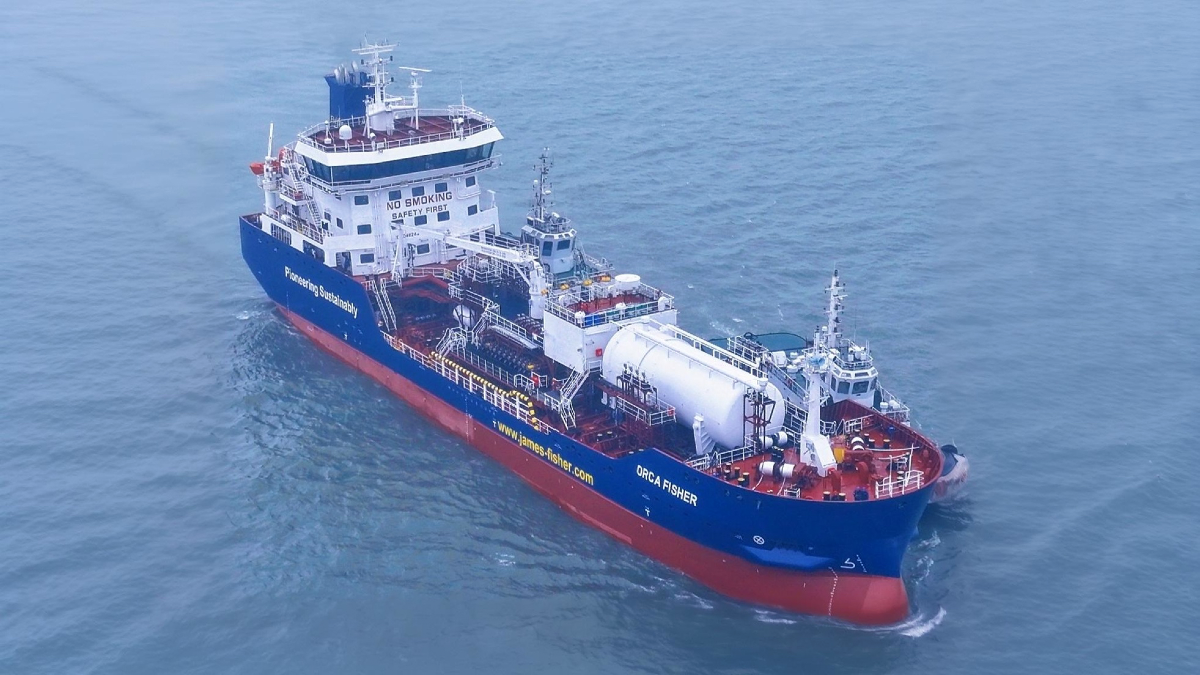
James Fisher continues to expand ‘fleet of the future’ with advanced coated product tanker
Orca Fisher, the first of four MarineLINE-coated chemical and product tankers, combines an advanced hull form, LNG-ready propulsion and a suite of energy-efficiency technologies to cut emissions


James Fisher and Sons plc took delivery on 16 March of Orca Fisher, the first of four LNG dual-fuel-powered, 6,000-dwt chemical and product tankers under construction in China. The delivery was announced by the ship designer, Sweden’s FKAB Marine Design, in a social media post.
Based on an FKAB T68 design and built to Bureau Veritas class by China Merchants Jinling Shipyard (Yangzhou) Dingheng, Orca Fisher is an advanced chemical tanker and part of the UK owner’s fleet of the future – a long-term newbuilding programme to modernise its tankship fleet with more efficient, lower-carbon vessels that support the use of alternative fuel propulsion. Three other vessels in the Sealife-class, Narwhal Fisher, Tiger Fisher, and Dolphin Fisher, are scheduled to join the owner’s fleet in 2026 and 2027, fulfilling the long-term demand for mid-sized ships in northwest Europe coastal shipping markets.
Each of the IMO Type 2 chemical tankers has an overall length of 93 m, a beam of 18 m, a depth of 9 m, and a design draught of 6 m, with 12 MarineLINE 784-coated cargo tanks, each fitted with an electrically driven deepwell cargo pump.
Orca Fisher is designed not only for loading efficiency, but also for fuel and energy efficiency. Propulsion power for the single-screw vessel is supplied by a four-stroke, medium-speed Wärtsilä 25 LNG dual-fuel engine, equipped with selective catalytic reduction (SCR) technology. The 6L25DF dual-fuel engine is IMO Tier III compliant when operating on LNG or liquefied biogas, and only uses SCR technology in diesel mode to achieve nitrogen oxide emissions compliance. The vessel is fitted with a Type C 280-m3 LNG fuel tank.
The Sealife-class tanker is designed for a service speed of 11 knots at 85% maximum continuous rating at design draught with15% sea margin and an accommodation electrical load of 200 kW. Based on those factors and 3% transmission losses, the ship designer estimates the fuel consumption at 7.8 tonnes per day in marine diesel oil mode and 6.3 tonnes per day in LNG mode.
The prime mover can operate as an auxiliary engine during cargo discharge and other low-load cases by using skip–firing, in which specific cylinders are deactivated to optimise engine load and improve efficiency.
In describing the vessel’s hull form, the Swedish naval architectural firm said the tanker has a patented F-bow – a specialised bulb-shaped bow – to improve its efficiency.
“Among many things, special attention is made regarding crew safety, propeller and rudder performance, optimal combination of main engine and propeller with regards to rpm and pitch for all speeds, electrical consumption, heat/cooler consumption, environmental protection, and minimum external and internal noise,” said the ship designer in a brief.
Other energy efficiency measures include a 1,200-kW shaft generator and a variable frequency drive for load optimisation.
When the keel was laid for Orca Fisher last year, James Fisher Tankships Product Line director, Mike Arkley, heralded the ship as part of the company’s “ongoing and unwavering commitment to decarbonise the fleet and strengthen operational performance for our customers”.
Riviera’s International Chemical and Product Tanker Conference will be held in London on 21-22 April 2026. Use this link for more information and to register for the event.

Related to this Story

Events

Maritime Regulations Webinar Week
 16 Dec 2025
 GMT - ONLINE
Floating energy: successfully unlocking stranded gas using FLNGs and FSRUs
24 Feb 2026GMT - ONLINE
© 2026 Riviera Maritime Media Ltd.


