


Business Sectors
Business Sectors
Events
Contents
Register to read more articles.
Japan tests high-output two-stroke hydrogen-fuelled engine for 2027 debut
A Japanese consortium conducted full-scale tests of a domestically developed hydrogen-fuelled engine, with plans to install it in a multi-purpose cargo vessel by 2027


A Japanese consortium has completed the first full-scale tests of a large-bore, two-stroke, slow-speed hydrogen-fuelled engine, operating with hydrogen co-firing at a 95% ratio in all cylinders. The promising results from tests on the first domestically developed two-stroke, hydrogen-powered marine engine advance its development towards installation as the prime mover in a Japanese 17,500-dwt hydrogen-fuelled multi-purpose vessel in 2027.
Developers, regulators, and operators still need to address hydrogen’s safety and operational risks, including high flammability, boil-off losses, and limited availability.
Tests by engine designer Japan Engine Corp (J-ENG) and fuel supply system manufacturer Kawasaki Heavy Industries (KHI) showed that the 6UEC35LSGH operated in hydrogen co-firing mode across all cylinders. To date, the six-cylinder engine has achieved a hydrogen co-firing ratio of more than 95% at 100% load, confirming both greenhouse gas reduction effects and stable operation, according to the developers. Verification testing will continue to further optimise performance under hydrogen co-firing conditions.
J-ENG and KHI are jointly engaged in the Green Innovation Fund Project, Development of Marine Hydrogen Engines and MHFS, of the Japanese government-backed NEDO, in co-operation with Mitsui OSK Lines (MOL), MOL Drybulk, Onomichi Dockyard, and ClassNK.
As Marine Propulsion reported last year, Mitsubishi Heavy Industries Marine Machinery and Equipment Co supplied its MET33MB exhaust gas turbocharger for the 6UEC35LSGH marine engine, which is rated at 5,610 kW at 167 rpm. Plans call for the 17,500-dwt vessel to begin demonstration operations for MOL Drybulk in 2028.
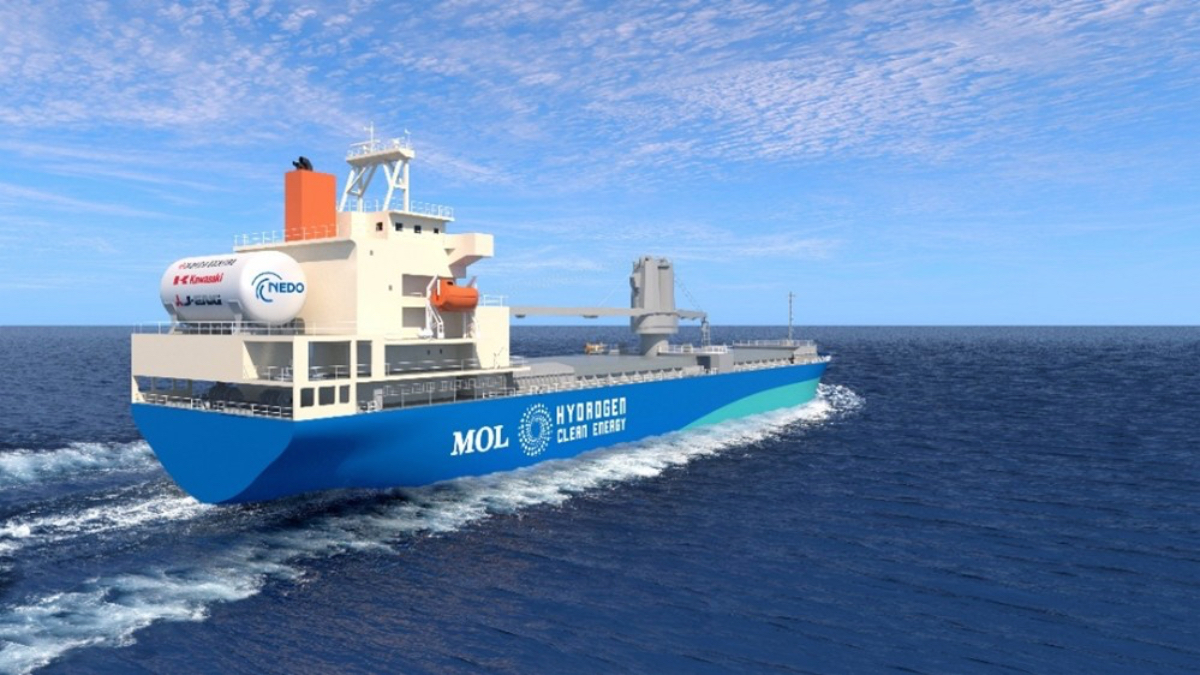
ClassNK granted approval in principle for the vessel’s design in 2023. A concept image shows the hydrogen fuel tank installed aft of the vessel’s bridge and superstructure.
Several hydrogen-fuelled vessels – including passenger ships, tugs, and offshore windfarm vessels – have been developed in Japan, Europe, and the US in recent years, demonstrating the use of compressed hydrogen technology primarily for domestic coastal or port-area operations. In contrast, the developers point out that this project combines the high-efficiency, high-output, low-speed, two-stroke hydrogen-fuelled 6UEC35LSGH engine with liquefied hydrogen fuel, enabling long-distance, long-duration, high-output operations. “This represents a major technological milestone toward the practical use of large oceangoing hydrogen-fuelled merchant ships,” they said.
Once full-scale verification is completed, the engine will be shipped in January 2027 for installation in the multi-purpose vessel, which is being designed and built by Onomichi Dockyard. KHI is developing and manufacturing the MHFS, a hydrogen fuel supply system for this engine.
MOL and Onomichi Dockyard have concluded a series of contracts for the construction of the vessel, and detailed design is “progressing smoothly.” Additionally, the parties said, “agreements were reached on the specifications of various facilities required for the hydrogen-fuelled vessel, and related contracts were executed.”
The dry cargo vessel is scheduled to undergo three years of demonstration operation starting in 2028 under the operation of MOL and MOL Drybulk. Throughout the development of the engine and MHFS, as well as the design, construction, and operation of the vessel, ClassNK will conduct safety evaluations.
Riviera’s Maritime Hybrid, Electric & Hydrogen Fuel Cells Conference & Exhibition will be held in Bergen, Norway, on 21-23 October 2026. Use this link for more information and to register for the event.

Related to this Story

Events

Maritime Regulations Webinar Week
 16 Dec 2025
 GMT - ONLINE
Floating energy: successfully unlocking stranded gas using FLNGs and FSRUs
24 Feb 2026GMT - ONLINE
© 2026 Riviera Maritime Media Ltd.


