


Business Sectors
Business Sectors
Events
Contents
Register to read more articles.
Multi-fuel future takes shape in Singapore
Landmark green methanol bunkering highlights the gradual transition to lower carbon intensity fuels at port


In 2025, alternative fuel bunkering at the Port of Singapore reached record highs, driven mostly by a jump in LNG bunkering. But 2026 could well see a sharp increase in methanol bunkering at the port, following the award of three new licences on 1 January by the Maritime and Port Authority of Singapore (MPA).
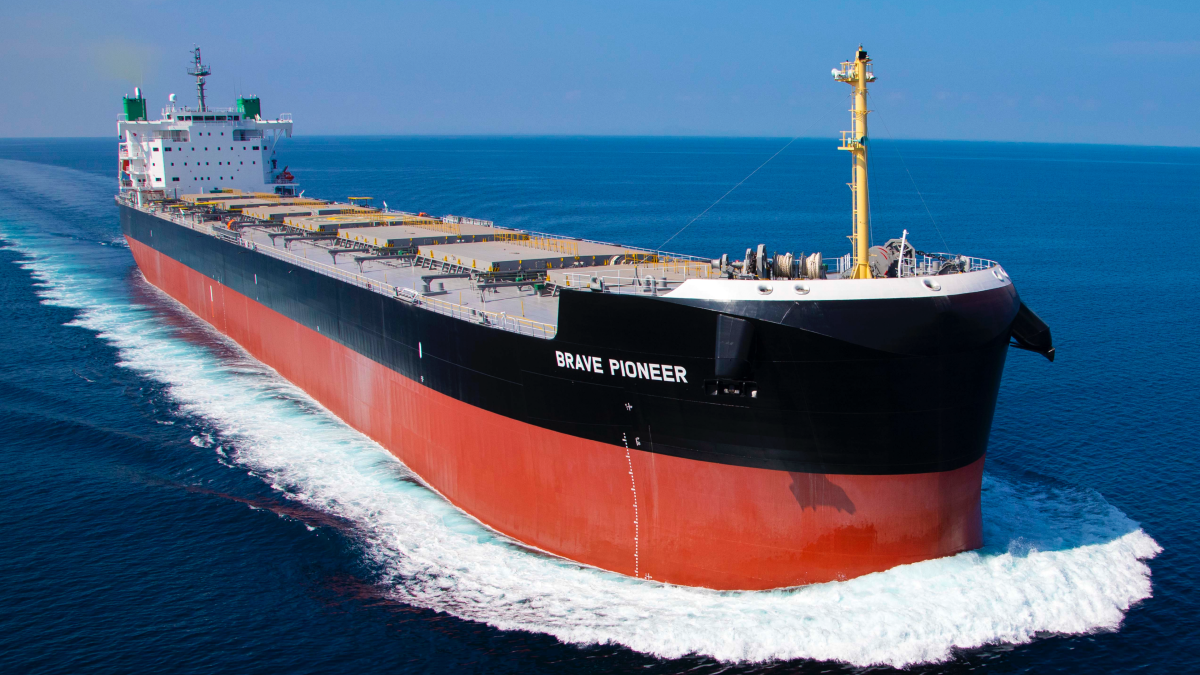
One of those new licence recipients, Golden Island Pte, completed Singapore’s first methanol bunkering operations on the Singapore-flagged Brave Pioneer on 20 January.
MPA awarded the licences to the three companies after completing a comprehensive evaluation that assessed supply chain reliability, operational readiness, and safety systems of the methanol to be supplied.
Others receiving the five-year licences, valid from 1 January 2026 to 31 December 2030, were Global Energy Trading and Petro China International (Singapore).
Owned by Mitsui & Co and chartered by Cargill, Brave Pioneer received a total of 300 metric tonnes of methanol from the IMO Type 2 tanker Golden Antares during the bunker delivery, ahead of its maiden voyage to Europe. While IMO’s Net-Zero Framework has stalled, shipowners still must comply with the regional carbon levy implications of FuelEU Maritime and EU ETS.
As a new dual-fuel dry bulk carrier, Brave Pioneer can operate on both conventional marine fuels and methanol. It is the first of five methanol dual fuel-powered dry bulk ships chartered by Cargill. One of the world’s largest vessel charterers, Cargill is assessing several technical and operational initiatives to lower carbon emissions from its operations. Besides green methanol, these include wind-assisted propulsion, voyage optimisation technologies, retrofits of energy-saving technologies, biofuels and ethanol.
“Decarbonising global shipping requires a mix of technologies and the willingness to take bold steps before the entire ecosystem is ready,” said Cargill Ocean Transportation business president, Jan Dieleman. “Technologies like green methanol or wind-assisted propulsion come with uncertainty. But as an industry leader, we have a responsibility to test these innovations on the water, share what we learn, and help shape the systems and standards that will enable wider adoption.”
By using green methanol, Cargill anticipates a CO2 emissions reduction of up to 70% as compared with traditional marine fuel.
During the bunkering, Golden Island complied with TR129 standards, which set requirements for the handling, transfer and measurement of methanol as a marine fuel in Singapore, including ship-to-ship transfers. Golden Island had also completed its mass flow metering (MFM) test onboard its bunker tanker in preparation for this operation.
“Green methanol or wind-assisted propulsion come with uncertainty”
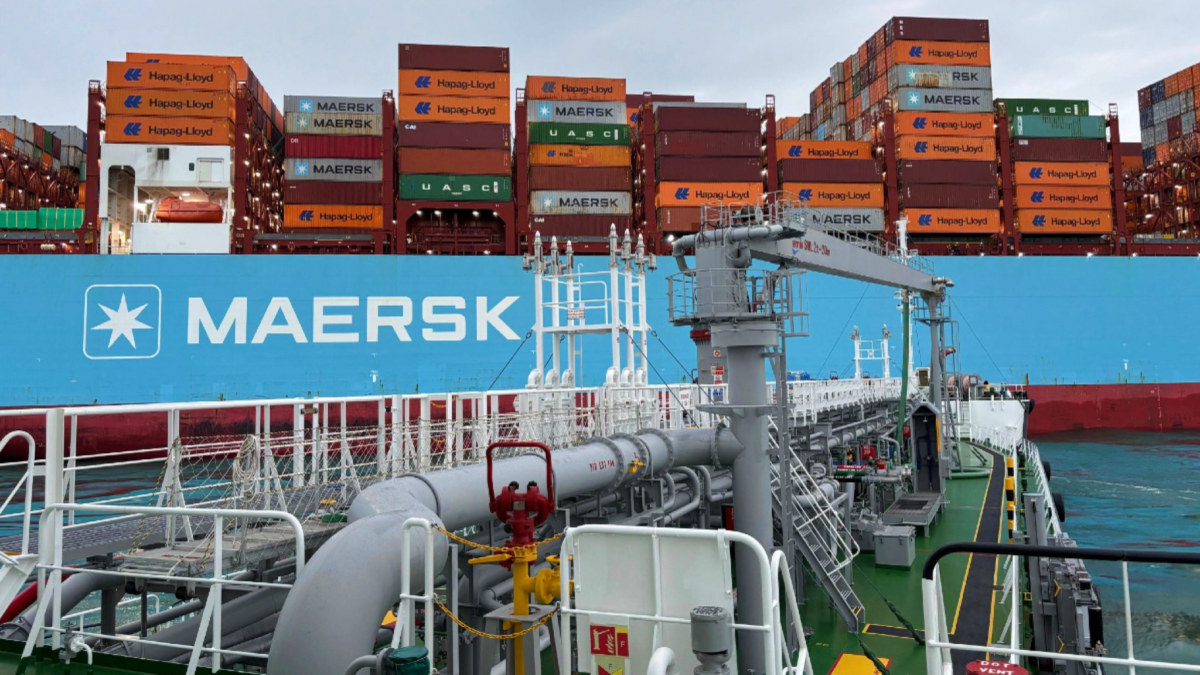
Maersk container ship Antonia Maersk was fuelled with methanol in Singapore on 28 November 2025, marking the first trial of a new TR129 standard.
MPA worked with Global Energy Trading Pte and Stellar Shipmanagement Services Pte on the refuelling effort, which saw 3,102 metric tonnes of methanol bunkered from the MT Kara to Maersk’s Antonia Maersk.
To demonstrate compliance with TR129, MT Kara’s Mass Flow Metering (MFM) system underwent an acceptance test to verify compliance and its performance was validated prior to the operation. The bunkering was conducted beyond daylight hours with detailed risk assessments and mitigation measures in place, including on-site weather monitoring by Kara and MPA patrol craft equipped with portable lightning detectors, according to the MPA.
Alternative fuels rising
Last year at the Port of Singapore, marine bunker sales reached a record 56.77M tonnes – a 3.4% jump from 2024. While conventional marine fuels still represent almost 97% of the port’s bunker sales by volume, sales of biofuels, LNG and methanol jumped during the year, demonstrating a desire among owners to use new fuels to reduce CO2 and greenhouse gas (GHG) emissions, while highlighting the growing number of ships equipped with dual-fuel engine technology entering the global fleet.
Sales of alternative marine fuels (biofuels, LNG and methanol) reached 1.95M tonnes in 2025, up from 1.35M tonnes in 2024. Biofuel sales increased 56.2% to 1.38M tonnes, LNG, 23.9% to 571,000 tonnes and methanol, 87.5%, to 3,000 tonnes.
No ammonia bunker sales were recorded by the port during 2025. This could well change this year, with the first ships equipped with ammonia dual-fuel engines entering service. Plans call for publishing Singapore’s first Technical Reference for Ammonia Bunkering in Q2 2026.
LNG bunkering licences
With more LNG dual-fuel ships entering service, the port is also looking to increase the number of licensed suppliers in Singapore. On 14 January, MPA issued a call for applications for additional licences to supply LNG as a marine fuel in port, following recent updates to the Singapore LNG bunkering licensing framework and standards.
MPA and Enterprise Singapore, through the Singapore Standards Council (SSC), is upgrading its existing Technical Reference for LNG Bunkering (TR56) to a Singapore Standard in Q2 2026 to strengthen requirements for safe, transparent, and quality-assured LNG bunkering. MPA is also asking licensees to outline the potential supply of liquefied bio-methane and e-methane in the Port of Singapore.
“Biofuel sales increased 56.2% to 1.38M tonnes”
Licensees are required to implement end-to-end LNG bunkering supply arrangements, including securing LNG supply, demand planning, cargo transfer operations, storage and safe handling of LNG, as well as the sale, supply and delivery of LNG fuel to vessels in Singapore.
Applicants are required to own or charter at least one LNG bunker vessel during the entire licence period. The LNG bunker vessel will be required to be registered with the Singapore Registry of Ships and comply with MPA’s Standards for Port Limit LNG Bunker Vessels. Applications are due by 27 March 2026.
Currently, there are three LNG bunker supplier licensees in the port: FueLNG Pte Ltd; Pavilion Gas Pte Ltd; and TotalEnergies Marine Fuels Pte Ltd.
Sign up for Riviera’s series of technical and operational webinars and conferences:
- Register to attend by visiting our events page.
- Watch recordings from all of our webinars in the webinar library.
Related to this Story
Events

Maritime Regulations Webinar Week
 16 Dec 2025
 GMT - ONLINE
Floating energy: successfully unlocking stranded gas using FLNGs and FSRUs
24 Feb 2026GMT - ONLINE
© 2026 Riviera Maritime Media Ltd.


