


Business Sectors
Business Sectors
Events
Contents
Call to action for environmental compliance


A veritable who’s who of the shipping industry lined up at this year’s Annual Marine Propulsion conference in London in March to demand that action be taken immediately to comply with upcoming environmental legislation. 191 delegates registered for the conference, an increase of 36 per cent versus last year. All sectors of the maritime industry were represented including regulators, class, shipowners, OEMs, shipbuilders, suppliers, industry organisations and academia.
The conference opened with a session entitled, “Slow steaming versus emissions trading” but as the various knowledgeable presentations demonstrated, the methods available to reduce emissions are not limited to just those two options. According to John Garner, fleet director of P&O Ferries, “Slow steaming may provide part of the solution, but it is not the whole solution. I propose that there are four different phases: operational, technical, infrastructure or market based instruments.”
An emissions trading scheme is a prominent market based instrument that generated much discussion. John Aitken, secretary general of industry group Shipping Emissions Abatement and Trading (SEAaT) commented, “A shipping emissions trading scheme must be global and apply to ships of all flags. I don’t believe that there would be any problems with respect to the amount of credits available. The people that I’ve spoken to within the emissions trading market feel that the shipping industry can be accommodated within it.”
It was a view shared by DNV chief operating officer Tor Svensen in his keynote speech, “If emissions trading is going to be adopted by the industry it must be global, it must be administered through IMO; it must not be regional. I don’t believe in a levy, I think we must accept some form of cap.” However, he also said, “Emissions trading should be short-term, because in the longer term I believe that we will come up with technical and operational solutions. Looking at slow steaming, Mr Svensen believes “a one- to two-knot reduction gives a lot of benefit on emission reductions but does not influence the economies of trading too much”.
Wayne Ross, marine services business development manager at Rolls-Royce added his voice to the debate at the end of session one, “Where I think manufacturers need to go is to make the engine as flexible as we can.” But Peter Swift, managing director of Intertanko warned, “I think that we all agree that flexibility is very desirable over the load range if the engine, but we tend to forget that we also need flexibility of that engine over a series of different load conditions of the ship.”
Vice president of research and development at MAN Diesel, Søren Jensen predicted, “We can improve thermal efficiency and gain further efficiency by combining this with waste heat recovery.” Conversely, Klaus Heim, vice president of research and development at Wärtsilä Switzerland disagreed with Mr Jensen’s assessment, “We have squeezed the performance out of our engines very much in the last 25-30 years and I can’t see much potential to further improve thermal efficiency. However, there’s definitely quite some potential in turbocharging technologies in addition to fuel injection.”
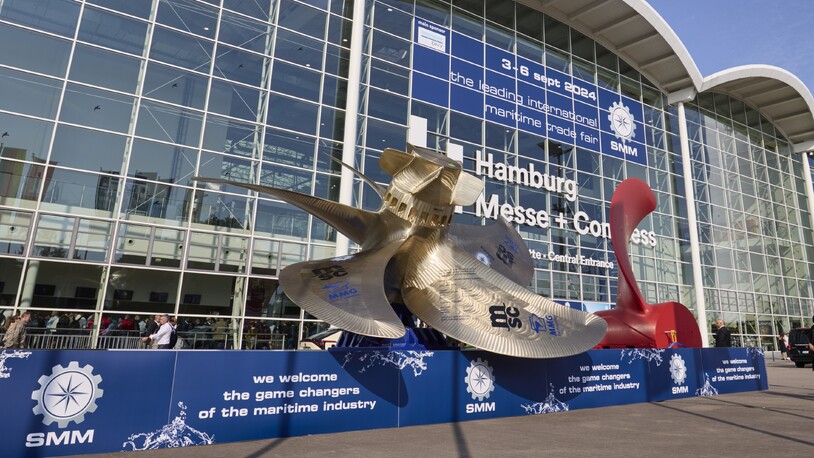
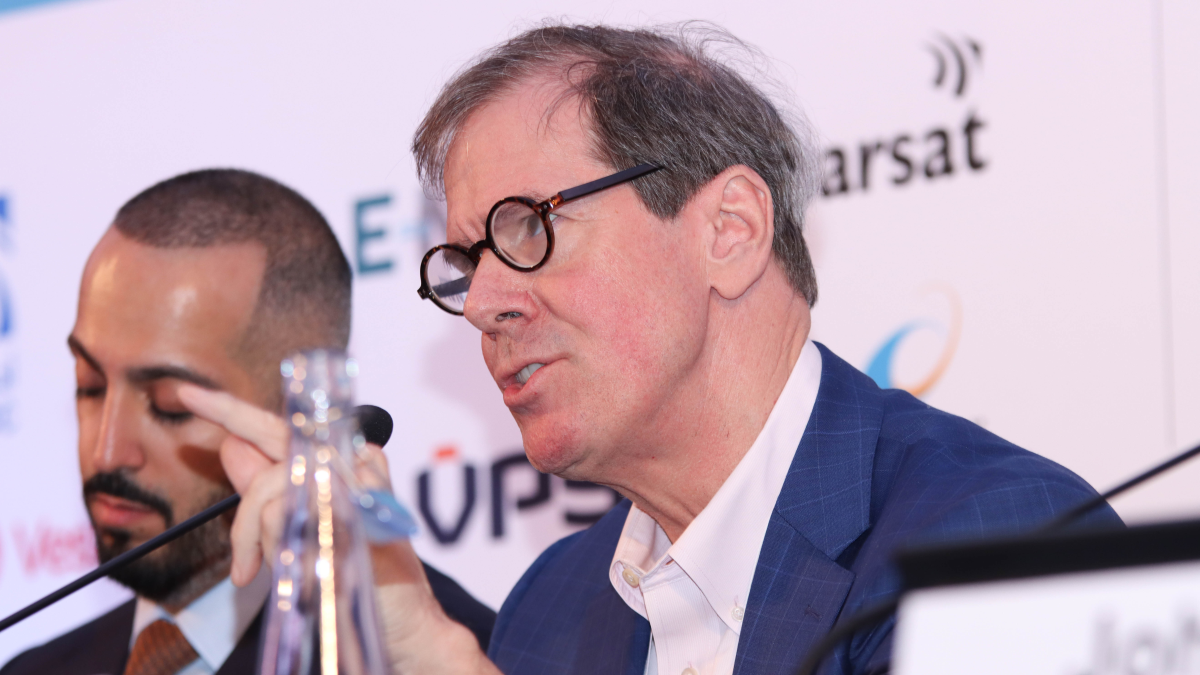
One issue that brought consensus from all participants was the call for immediate action in order to prepare for future regulations. According to Mr Svensen, “I think now is the time for shipyards to be investing in totally new designs that are much more energy efficient.” It was a viewpoint that was emphasised in the session relating to “Green Visions” (session panel pictured). Claus Jensen, vice president and fleet manager of the technical division at Torm gave an impassioned presentation described by conference chairman Edwin Lampert as “a searing indictment of our industry”. Said Mr Jensen, “If we don’t do something now, then a group of ministers with limited knowledge and limited experience of the industry will make the decision for us. We haven’t been proactive as an industry. We have to create environmental awareness internally and externally.”
The timescale for the impending Marpol Annex VI legislation limiting sulphur emissions was also a cause for concern. Andrei Ludu, deputy product line manager and head of product management of large engines at AVL List commented: “In 2015 we will have to use 0.5 per cent sulphur fuel. We are still talking about multiple choices for major emissions reduction technologies such as selective catalytic reduction. These will have a major impact on engine technology. We do not have time to engineer those technologies and validate them. We need input from shipowners and operators very quickly to have a chance of making it in time.”
Norwegian Cruise Line’s environmental systems manager Eric Wolff discussed how the company is turning onboard refuse into revenue. “By properly sorting and packaging out rubbish, we turned it into a commodity and we now sell it to the Port of LA. The process is all about planning, teambuilding and communicating.”
Low sulphur fuels were the focus of another session during the conference’s first day. Geoff Jones, general manager of Lintec Testing Services, described how increasing use of low sulphur fuels for (sulphur) emission control areas (SECAs/ECAs) is pushing fuel parameters off-specification due to the blending process involving large amounts of cutter stock. This can raise the levels of catalytic fines found in these fuels and decrease the stability in ignition/combustion characteristics.
Jean-Philippe Roman, technical director at Lubmarine was questioned about the need for BN40 fuel after his paper on the development of Total’s Talusia Universal lubricant and responded by saying, “BN40 may be necessary as with the new regulations we will increasingly have to continuously use low sulphur fuels and up until now the engine manufacturers or the oil industry have no examples of the effects of this. We have some examples of failures due to excess of calcium carbonate or excess of BN but these results were only gained from operations over a short period of time.” Session chairman Ian Adams, secretary general of IBIA, commented, “We hear repeatedly about the issue of extended operation of those fuels, but no-one will ever define what an extended operation is.”
Day two of the conference began with a joint presentation by two representatives of Marinvest Shipping: Roger Karlsson, technical director, and Bo Bengtsson, senior technical advisor. They detailed Marinvest’s experience of developing a ‘take me home’ device to reduce the accident risks connected with a main engine breakdown and to make planned maintenance easier. The system consists of a power take in (PTI) unit combined with a controllable pitch propeller to give good manoeuvring capability and power control. The PTI system is fully disconnected, with no interaction with the propulsion system. It has now been successfully installed aboard four Panamax tankers.
During this session on power and propulsion requirements, chairman Peter Swift suggested that newbuildings will have to be at least 50 per cent more efficient than they are today to reach the target of a 20 per cent greenhouse gas reduction by 2020. On this issue, Wärtsilä’s ship power research and development director, Oskar Levander believes, “If you take into account economy of scale, bigger vessels, and look at logistics, timing and scheduling, as well as making more efficient ships themselves, then I think 50 per cent can be achieved. But unfortunately I don’t think that all of those developments will happen. However, we need to do all we can. The number one element is to look at is the main dimensions. Another important thing to examine is how to recover waste heat.” Mr Karlsson added, “The main factor in developing these results is speed. We must realise that running at high speeds at sea is very expensive.”
In the “maintenance and performance” session, Espen Liset of Kongsberg Maritime and Dr Hinrich Mohr of AVL List jointly presented the case for condition monitoring systems. The AVL EPOS open diagnosis platform was developed in close co-operation with Kongsberg and can additionally automatically analyse engine status, based on the available data.
Wayne Ross discussed leveraging the condition monitoring experience of Rolls-Royce’s aerospace division to use in the marine industry. “We have tried to make our equipment as user friendly as we can, to allow the people on a vessel to use it for their maximum benefit. So the knowledge level of the seafarers is not as important as you might think. But obviously if you have a very highly trained crew then they can actually get more benefit from the system.”
Session chairman Dr Gopinath Chandroth, marine accidents inspector at MAIB noted, “There are lots of accidents at sea which could have been quite easily prevented by a simple act such as condition monitoring.”
BP Shipping is also looking closely at its maintenance strategy, as chief engineering superintendent Andy Trumble explained, “We have done a criticality assessment of every single piece of equipment and from that we have introduced a tiered approach to maintenance, driven from that criticality.” He also emphasised that it is essential to ensure that seafarers buy into the system.
The final session detailed emerging and alternative propulsion systems. Hans Petter Grønlund, senior project manager, Wilhelmsen Marine Consultants, detailed how the optimal engine plant for Wilh Wilhelmsens’s new generation roro carriers will be a modern electronically controlled two-stroke slow speed engine with a fixed pitch propeller. The vessels will also utilise a steam generator in combination with a shaft generator and three diesel gensets, which is estimated to enable a 90 per cent fuel saving compared with a conventional diesel genset arrangement.
Gijsbert de Jong, product manager at Bureau Veritas described how hydrogen fuel cells are a promising, clean solution, but the technology is not yet mature enough for a full scale fleet roll-out. “There is currently a lack of regulatory framework and the system for converting chemical energy to DC power is complex.” Andrei Ludu chaired the session and forecasted that “these ship system variants will bring us towards a cleaner engine but the engine will become a far more complex machine”.
In response to feedback from the 2008 event, this year saw an expanded exhibition, which was the fulcrum of the coffee breaks and lunches over the two days. The popular pre-conference drinks reception and gala dinner were once again a mainstay of The Annual Marine Propulsion Conference. This year’s keynote speaker, Jim Davis CBE, chairman of the International Maritime Industries Forum, gave an entertaining speech underwritten by a serious message. The industry would face “a year or more of entrenchment and serious thought” he told a rapt audience, but this was no reason for depression, rather it needs to be seen as “all part of a global readjustment”.

Related to this Story
Events

Maritime Regulations Webinar Week
 16 Dec 2025
 GMT - ONLINE
Floating energy: successfully unlocking stranded gas using FLNGs and FSRUs
24 Feb 2026GMT - ONLINE
© 2026 Riviera Maritime Media Ltd.


