


Business Sectors
Business Sectors
Events
Contents
Isochronous or speed droop control for gensets?


Electric loading on generators – active loads (kW) and reactive loads (kVar) – is required by rules and regulations to be equally shared between paralleled gensets in the plant. This means that two equally-sized gensets shall have the same load in kW and kVar within the tolerance defined by classification rules.
Gensets of different sizes share the loadings to an equal percentage of their ratings. The load sharing should be automatic but with the possibility of unequal sharing for test purposes or if dictated (for example, after lengthy periods of low load operation).
Reactive load sharing is controlled by an automatic voltage regulator (AVR). The generator voltage in ship networks is allowed to vary, typically up to 5 per cent. Exploiting this freedom, and by using digital AVR with high resolution and performance, voltage regulation is made by setting the AVR in droop control, allowing the voltage to reduce with increasing reactive load.
By equal setting of the voltage reference value Vref, and the droop Dv, the two parallel generators will share the reactive load equally.
There are also solutions for sharing the reactive load equally without voltage variations, but this requires communication between the AVRs and hence increased complexity and potentially common fault modes. Since the operation, synchronisation and performance of the electrical power plant for most installations will tolerate a small voltage variation, voltage droop control without droop compensation is overwhelmingly the most common solution for ships.
Active load sharing is controlled by the diesel engine speed controllers (governors). Controlling the speed of an engine also directly controls the frequency of the synchronous generator. The engine may well be controlled in speed droop control, similar to the voltage droop control of the generators. The loads of the plant may vary significantly.
Large power variations in the load are challenging for the engine controller and will cause frequency variations. While the voltage variations from droop control of the generators normally do not have a detrimental impact on the operations of the electric system, large frequency variations will create higher losses in the plant and may also make synchronisation of generators more difficult.
This is the case even if the speed reference is being adjusted by the power management system, as this compensation of the droop is normally slow.
An isochronous speed controller will not eliminate frequency variations due to its control bandwidth but it reduces the excursions from the set point quite efficiently for most normal load variations.
The characteristics of these methods can be summarised as:
Droop mode:
larger frequency variations with varying loads
lower margins to over- or under-frequency trips (can be compensated by power management speed reference adjustments)
no single point of failure in the controllers: if the power management system has an overall load sharing control and speed reference adjustment, a failure there has no instant impact on the power plant.
Isochronous mode:
quick response to load changes/frequency variations
stable net frequency, even with variable loads, ensuring larger margins to critical under- and over-speed trip limits
asymmetric load sharing requires additional functionality (for example, mode change)
failure in load sharing line (earth failure, short circuit) may be a single point of failure
monitoring of load sharing line is required with automatic switching to droop mode when a fault is detected.
As each ship type has different operational requirements and load characteristics it is not easy to declare which method is better.
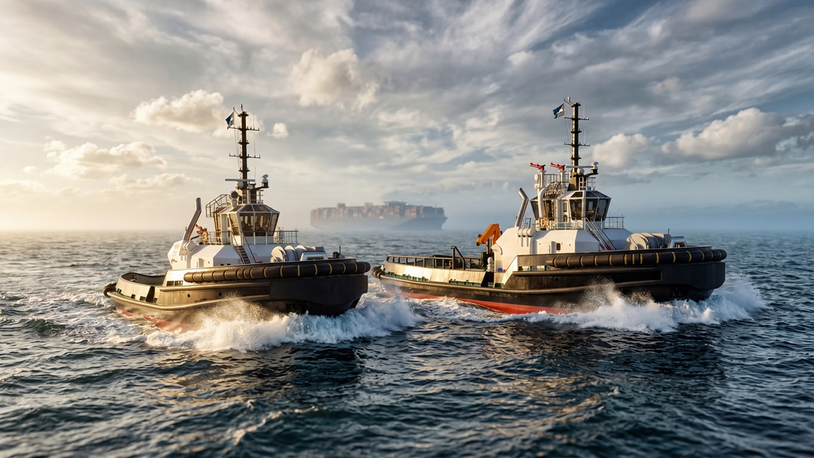
For many ship types - especially smaller vessels where the thrusters and propellers may be strongly disturbed by the water motion and air suction in harsh weather - the use of an isochronous speed control system is more common. This stabilises the network frequency and simplifies synchronisation of generators and bus ties in such weather.
To increase the flexibility of controls, the generators are normally equipped with mode change that also enables operation in speed droop.
For other ship types, such as drilling vessels, the thrusters are less exposed to the weather impact and, even with large variations in the process loads, speed droop is usually used. Normally, the automation system’s power management is allowed to adjust the speed reference to keep the frequency more stable and close to the set point, and thereby also increasing the margins to over- and under-frequency trip limits. MP
Source: ABB



Related to this Story

Events

Maritime Regulations Webinar Week
 16 Dec 2025
 GMT - ONLINE
Floating energy: successfully unlocking stranded gas using FLNGs and FSRUs
24 Feb 2026GMT - ONLINE
© 2026 Riviera Maritime Media Ltd.


