


Business Sectors
Business Sectors
Events
Contents
Register to read more articles.
Relocate access points beyond hazard zones to clear tanker adoption hurdle
A wind-assisted propulsion system developer says they have addressed a significant ATEX certification challenge that has hindered adoption in the tanker sector


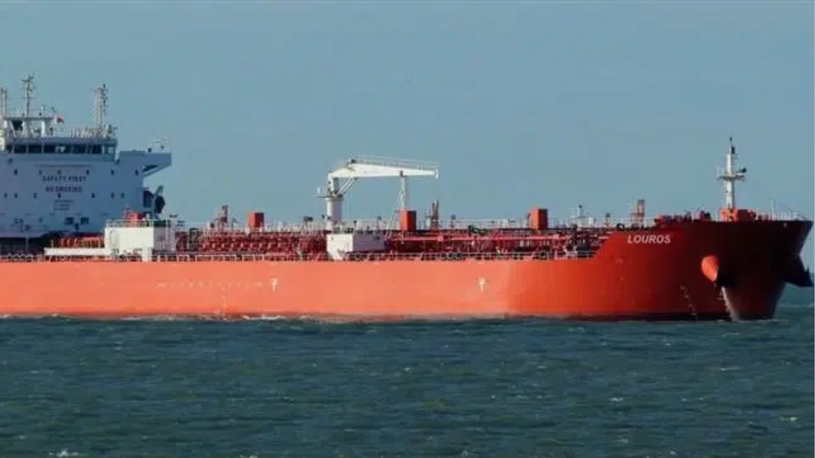
According to its architects, repositioning maintenance access points away from hazardous zones eliminates a cost barrier that has made such systems economically challenging for vessels carrying flammable cargoes.
The approach comes from bound4blue, a Spanish cleantech company founded in 2014 by aeronautical engineers José Miguel Bermúdez, Cristina Aleixendri and David Ferrer Desclaux. The company develops automated wind-assisted propulsion systems for commercial shipping through its eSAIL technology, a rigid suction sail designed to reduce fuel consumption by generating additional thrust from wind.
"We’ve found a way of putting non-ATEX-proof equipment on tanker vessels that have hazardous zones," states bound4blue chief technical officer and cofounder, David Ferrer Desclaux. "This gives us an advantage compared with other technologies because they need to be ATEX-proof, which makes them more expensive."
bound4blue’s lateral thinking – quite literally – produced a transformative approach, "Instead of accessing from below, we go in from the side. The lower side of our section area is now a door so we can go on the platform, go on our winglet and get into the system. Both the equipment and the access are from outside.
"If you put the equipment outside hazardous zones, that’s fine. But usually, the access is from below," says Mr Ferrer Desclaux. "An opening in the foundation creates an opening to a hazardous zone, so the full confined space becomes a hazardous zone."
Mr Ferrer Desclaux’s aerospace engineering background has profoundly shaped bound4blue’s approach to maritime challenges, bringing both advantages and initial hurdles.
"When we started bound4blue, our background had nothing to do with shipping. We had no idea about shipping," he acknowledges. "That had both positive and negative aspects. The negative was obviously having to learn a lot. But it also allowed us to approach problems differently."
Its suction sail technology – drawing from aircraft wing design principles – epitomises this cross-sector innovation approach.
"The suction sail has not been analysed extensively. It was invented in the 1980s by the Jacques Costeau Foundation. We took that information and we’re evolving it," Mr Ferrer Desclaux explains. "There are so many ways of changing and redesigning things that have not been explored. We have a very long list of research and development tasks, especially regarding aerodynamics, because there’s a big margin still to improve."
This contrasts sharply with more established technologies, he says. "A Flettner rotor is a spinning object. There’s not so much more to do on the aerodynamics. It’s a magnus effect and that’s all. On the suction sail, there are plenty of ways of improving the aerodynamics."
He adds the bound4blue system confronts another persistent industry misconception: that suction sails deliver inferior performance compared with competing technologies. "The discussion is not about performance because you can get the same savings with any technology. It’s just a matter of size. The discussion is what are the implications of putting that size and that technology on board."
While bound4blue’s current installations represent significant advances, its research and development pipeline points toward more integrated and optimised future systems.
"We’re constantly exploring improvements. We’re doing one or two wind tunnel tests annually because we’re improving performance by testing different configurations and different ways of doing suction," Mr Ferrer Desclaux reveals.
The next evolution focuses on deeper integration with vessels’ existing systems. "The sails generate thrust, and then you manage it how you want. But the sails are essentially a second engine. If you can integrate it with the existing engine, there are ways of optimising their performance."
This integration will extend to weather routeing systems, a natural synergy for wind propulsion, "Weather routeing is the obvious one. Wind propulsion depends on wind. If there’s a way of getting better wind, you’re going to save more. It’s a win-win collaboration."
The technology has faced scepticism regarding its viability for larger vessels – a question Mr Ferrer Desclaux responds to with engineering precision.
"That’s a misconception," he states. "The good thing about aerodynamics is they are non-dimensional. The calculations and coefficients apply independently of size. Whatever you test in the wind tunnel at 1-m scale applies to 36 m or 100 m.
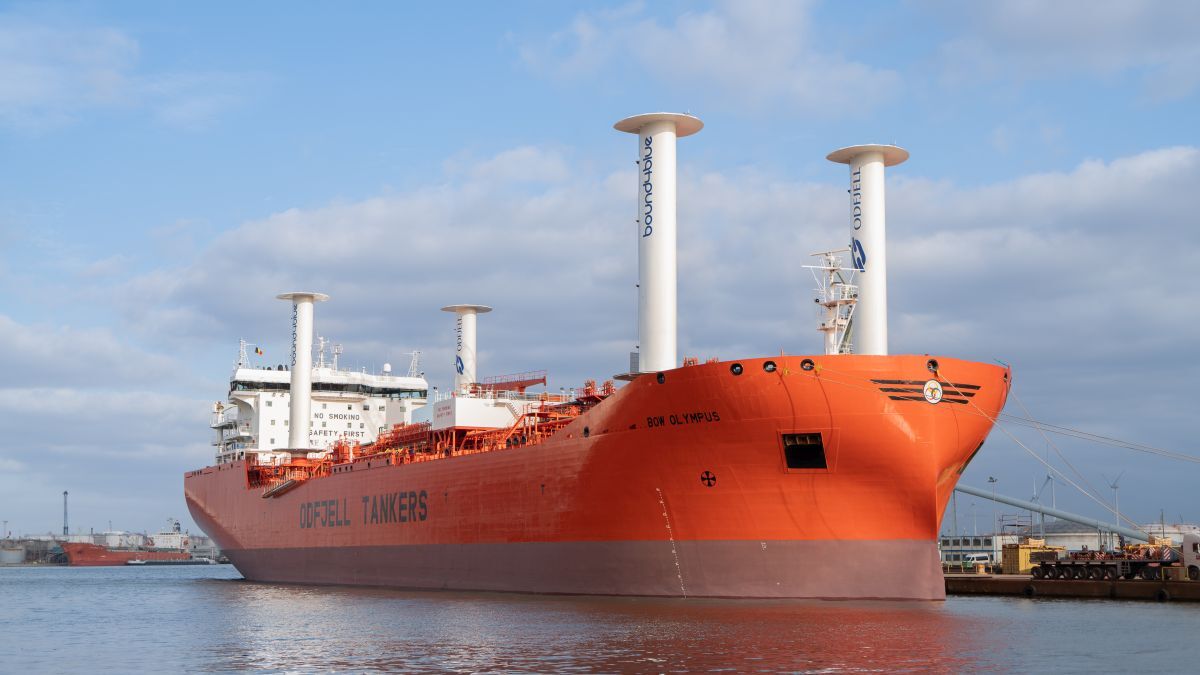
"The main challenge today is shipyards aren’t familiar with the system. They think it’s going to be very difficult because it’s high tech," he observes. "But once we explain what it is, they basically say it’s not so complex; a two-day upgrade was completed on Bow Olympus at EDR Antwerp Shipyard with minimal disruption. The mechanical connection is a flange, like installing a deck crane. The electrical interface is two junction boxes with signal and power cabling."
Directly addressing concerns about long-term maintenance costs, Mr Ferrer Desclaux focuses on seafaring practicalities often overlooked in technical discussions.
"If you have a composite sail hit by a crane at port, who in the shipping industry knows how to repair those materials? Everyone knows how to repair naval grade steel," he says.
The company offers a one-year guarantee for new installations, with longer-term maintenance approaches being determined based on actual operational experience rather than speculative projections.
bound4blue has also leveraged existing industrial capacity by designing its system to match established production capabilities.
"Our technology has been adapted to look similar to offshore wind turbine towers. It’s basically a steel tube," Mr Ferrer Desclaux explains. "We’re working with companies that build these towers. They already know how to build our sails. Our supplier in Spain can build 1,500 wind turbine sections per year," he concludes.
Sign up for Riviera’s series of technical and operational webinars and conferences:
- Register to attend by visiting our events page.
- Watch recordings from all of our webinars in the webinar library.
Related to this Story
Events

Maritime Regulations Webinar Week
 16 Dec 2025
 GMT - ONLINE
Floating energy: successfully unlocking stranded gas using FLNGs and FSRUs
24 Feb 2026GMT - ONLINE
© 2026 Riviera Maritime Media Ltd.


