


Business Sectors
Business Sectors
Events
Contents

Register to read more articles.

Rolls-Royce keeps faith with diesel as mtu turbochargers prepare for methanol
Rolls-Royce has laid the foundation to support the transition to methanol, but continues to invest in making its diesel engines cleaner and more efficient


Rolls-Royce sits a little apart from the other names in this guide. It designs and builds mtu turbochargers in-house, but first and foremost for its own engines, so its view of future fuels is refreshingly unfashionable.
Diesel is not going anywhere soon. So, the turbocharger story here is best read through the engine, as one part of a much bigger job.
That does not mean the turbochargers never leave home. Since 2021, Everllence, formerly known as MAN Energy Solutions, has distributed the latest mtu ZR1 to ZR5 family through its PBST brand, under the name HIRO, for high-speed diesel and gas engines from 400 to 2,500 kW.
That deal sat alongside an existing sales channel through Woodward L’Orange. Even so, the engine remains the heart of the business, and turbocharger engineering goes wherever the engine programme leads.
The programme belongs to Rolls-Royce in Friedrichshafen, southern Germany. Rolls-Royce took full ownership in 2014 when Daimler sold its 50% stake, and the business now employs more than 10,350 people.
“HVO already gives our customers an opportunity to reduce CO2 emissions”
While trade is booming, ships are not the only reason. Revenue rose 19% in 2025, driven mainly by backup power for data centers and by defense work.
Marine remains a core market all the same, and Tobias Kohl, vice president Application Engineering Marine & Offshore at Rolls-Royce, does not hedge. “Highly efficient diesel technology will remain a mainstay of marine propulsion for the foreseeable future, and we continue to invest in making our engines more efficient and cleaner,” he said.
He continued: “HVO already gives our customers an opportunity to reduce CO2 emissions using existing engine technology. At the same time, our extensive development work on methanol technology has laid a strong foundation for responding to future customer needs as the market evolves.” In an industry fond of writing the diesel engine’s obituary, that is a welcome dose of realism.
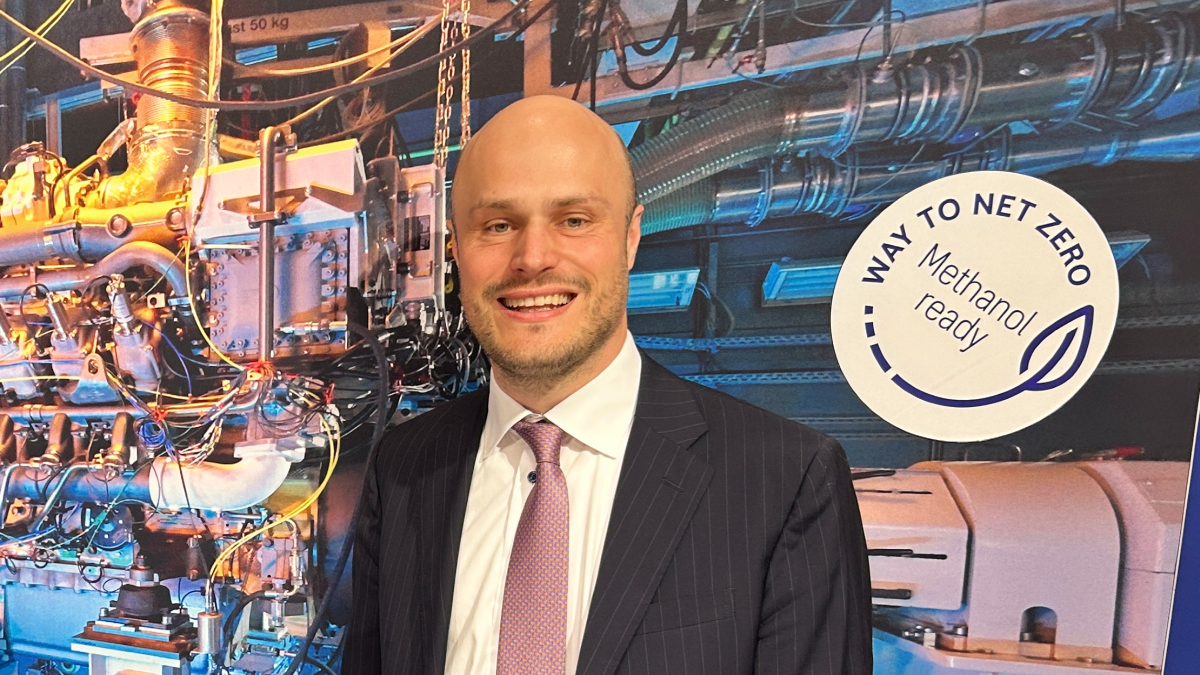
HVO is the drop-in route, and it asks nothing of the engine. Rolls-Royce says all of its current engine series are approved and certified for HVO without technical modifications.
The groundwork was laid in stages. Series 2000 and 4000 yacht engines were cleared for EN15940 fuels such as HVO in 2023, and the larger Series 1163 and 8000 followed in September 2024.
A new SCR system arrived at the same time for 16- and 20-cylinder engines from 4,800 to 10,000 kW. Rolls-Royce says it cuts nitrogen oxides by 75% against IMO II limits. Emissions are measured continuously upstream and downstream of the catalyst, keeping reducing agent dosing to a minimum. Efficient combustion backed by advanced aftertreatment is the formula.
The turbocharger is doing its share. On the 12V 2000 M96Z, the turbochargers run on ball bearings, which cut friction within the bearing system and on the turbocharger shaft. The payoff is transient response. The turbine accelerates faster, so the engine reacts more quickly when load increases.
Rolls-Royce says that this is most relevant in marine applications with frequent and rapid load changes. Anyone who has felt a fast craft hesitate as the throttle goes forward will understand why.
Methanol is the longer-term bet. At SMM in 2022, Denise Kurtulus, former vice president Global Marine, put it plainly: “We are clearly committed to methanol as a marine fuel for the future and want to be a pioneer here.” The reasoning was practical. Methanol offers high energy density compared with other sustainable fuels and stays liquid at ambient temperature, which keeps storage and bunkering simple.
Back then, Series 4000-based methanol engines were due on the market from 2026. Today, Rolls-Royce says broader introduction will depend on availability, infrastructure and cost.
The test bench has kept moving regardless. In October 2025, Rolls-Royce ran what it called the world’s first high-speed marine engine powered purely by methanol, at Friedrichshafen. The work came out of meOHmare, a research project funded by the German Federal Ministry for Economic Affairs and Energy, with Woodward L’Orange and WTZ RoBlau as partners.
“Ammonia gets shorter shrift”
Here the turbocharger steps back into the frame. Methanol will not self-ignite the way diesel does, so the engine needed entirely new injection technology. Dr Johannes Kech, head of methanol engine development, said the team “fundamentally redesigned the combustion process, the turbocharging, and the engine control system.”
Methanol also places specific demands on engine components. Rolls-Royce has tested intensively on single-cylinder research engines and full engines to ensure the relevant components and systems stay reliable and durable. With more than 5,000 hours of methanol running behind it, in single- and dual-fuel mode, the mtu Series 4000 received DNV’s Methanol Readiness Certificate at the end of August 2026.
It confirms a concept for converting newly built Rolls-Royce propulsion systems to methanol dual-fuel operation later in life. Lukas Köhler, senior vice president Global Marine & Mining, said owners can switch “as soon as the fuel is sufficiently available.”
Read that line twice. The pitch has moved from methanol engines on a fixed date to methanol when the fuel shows up. For an owner signing a newbuild contract today, that may be the more honest offer.
Ammonia gets shorter shrift. Rolls-Royce says it currently plays no role in the marine segments it serves, and its development effort is focused on the fuels its customers are expected to need.
Hydrogen has been explored on the power generation side. In 2023, a 12-cylinder gas version of the Series 4000 L64 ran on 100% hydrogen, with turbocharging among the systems reworked.
At Rolls-Royce, the turbocharger rarely gets top billing. Yet every time the fuel changes, it is among the first parts sent back to the drawing board.
The engine may stay diesel for years yet. The turbocharger is already learning to breathe something else.




Related to this Story

Events

Maritime Regulations Webinar Week
 16 Dec 2025
 GMT - ONLINE

Floating energy: successfully unlocking stranded gas using FLNGs and FSRUs
24 Feb 2026GMT - ONLINE
© 2026 Riviera Maritime Media Ltd.


