


Business Sectors
Business Sectors
Events
Contents
Register to read more articles.

Trump trade war makes resiliency shipping's new currency
Trump tariffs, port fees and US government policies roil shipping markets and ’victimise’ Chinese and Hong Kong maritime stakeholders, but highlight the need to diversify global shipbuilding


Faced with unprecedented levels of disruption and uncertainty caused by global trade wars, tariffs and Trump Administration policies, shipping must be resilient, but will face increasing inefficiencies and higher costs, say leading shipowning interests. But port fees levied on Chinese-built and -owned ships calling at US ports could result in more orders flowing to South Korean and Japanese shipyards.
In discussing the level and speed of the tariffs levied on imports by the Trump Administration, Norwegian Shipowners’ Association president and Odfjell SE chief executive, Harald Fotland, said “We’re trying to adapt to what’s coming, handling the challenges of imports and exports.”
This means diverting cargoes and developing new routes, resulting in inefficiencies in a very well-developed global supply chain.
Shipping will need to respond quickly, noted Dr Gaby Bornheim, German Shipowners’ Association president and Peter Döhle Schiffahrts-KG managing director. “Agility is the currency for shipping,” she said.
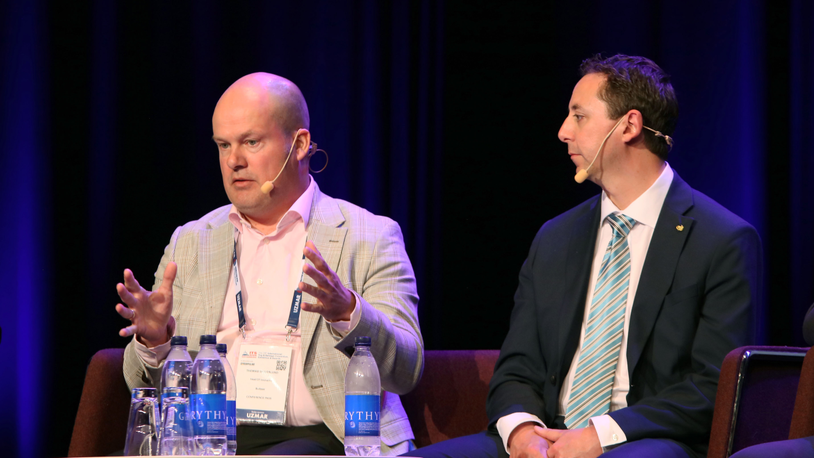
Speaking during a session at the 2nd Maritime Leaders Summit produced by Capital Link and DNV, Mr Fotland and other panellists did note that the Trump Administration’s focus on China’s dominance of global shipbuilding did highlight a critical issue the maritime industry needs to address.
“We have become too dependent on one shipbuilding nation,” Mr Fotland said.
NYK Group Europe president and chief executive Carl-Johan Hagman agreed, saying, “The world needs to be rebalanced.”
China secured almost 75% of the global shipbuilding orders last year. Mr Fotland said rebalancing this would probably result in higher costs but would potentially drive more ships to be ordered from South Korea and Japan.
But port fees levied on Chinese-built and -owned ships, would not result in orders being placed overnight at US shipyards, noting issues with pricing, quality, supply chain and delivery uncertainty, noted panellists.
And, by contrast, Mr Fotland said Chinese shipyards should be commended for building quality ships and their willingness to innovate. “There are plenty of great things to say about Chinese shipbuilding,” said Mr Fotland.
Wah Kwong Maritime Transport Holdings Ltd executive chairman, Hing Chao was frank when discussing the implications of the port fees assessed on Chinese ships calling at US ports.
“We feel victimised by this policy,” said Mr Hing Chao, who is also the co-founder and chairman of the Hong Kong Chamber of Shipping, which was established in 2024 to improve Hong Kong’s position as a maritime hub for the shipping, financing and trading sectors. The organisation’s membership brings together shipping corporations but also companies from the energy, commodities, port, finance and shipbuilding sectors, as well as maritime services as represented by classification societies, law firms, insurance institutions, and shipmanagement companies.
Sign up for Riviera’s series of technical and operational webinars and conferences:
- Register to attend by visiting our events page.
- Watch recordings from all of our webinars in the webinar library.

Related to this Story

Events

Maritime Regulations Webinar Week
 16 Dec 2025
 GMT - ONLINE
Floating energy: successfully unlocking stranded gas using FLNGs and FSRUs
24 Feb 2026GMT - ONLINE
© 2026 Riviera Maritime Media Ltd.


