


Business Sectors
Business Sectors
Events
Contents
Register to read more articles.
Viking’s hydrogen fuel cell-powered cruise ship advances on path to zero emissions
Viking Cruises’ 1,000-passenger Viking Libra will be one of the first ships to use hydrogen-powered fuel cells to operate with zero emissions in port and in environmentally sensitive areas


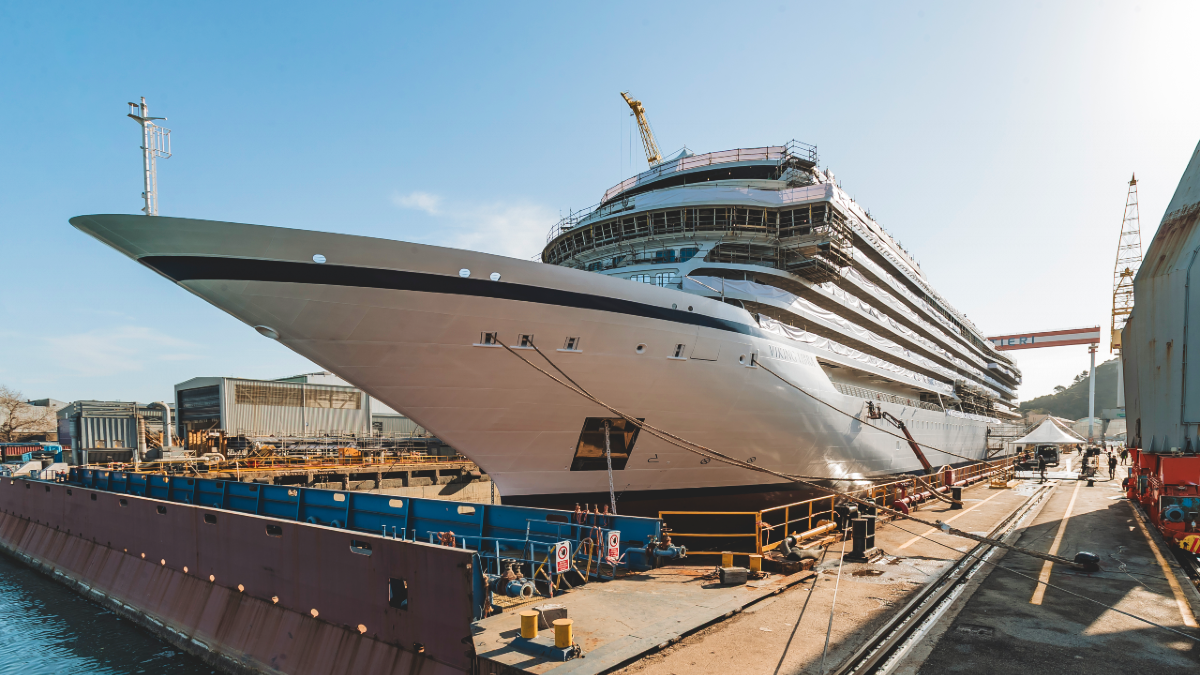
Marking a milestone in the construction of the world’s first hydrogen-powered cruise ship, a float-out ceremony was held in Italy for Viking Libra. Once delivered in November 2026, the 54,300-gt cruise ship will be capable of sailing with zero emissions when it begins service in the Mediterranean and Northern Europe.
Viking Cruises chairman and chief executive Torstein Hagen said, “From the beginning, our approach to ship design has focused on reducing fuel consumption, and Viking Libra is our most environmentally friendly vessel yet. Investing in hydrogen was a principled choice for Viking, offering a true zero-emissions solution, and we look forward to welcoming the world’s first hydrogen-powered cruise ship to our fleet.”
The float-out ceremony took place at Fincantieri’s Ancona shipyard, marking the ship’s transition into the final stage of construction. With Viking Libra now afloat, the vessel will be moved to the shipyard’s outfitting dock for final construction and interior build-out.
The ceremony was attended by Fincantieri Ancona shipyard director Gilberto Tobaldi, Viking Cruises executive vice president of product Karine Hagen, and senior vice president of ocean passenger operations Enrico Prunotto.
Classified as a ‘small ship’ by Viking, the luxurious, all-veranda Viking Libra has an overall length of 239 m, a beam of 31 m, nine decks and 499 staterooms for 998 guests.
PEM technology
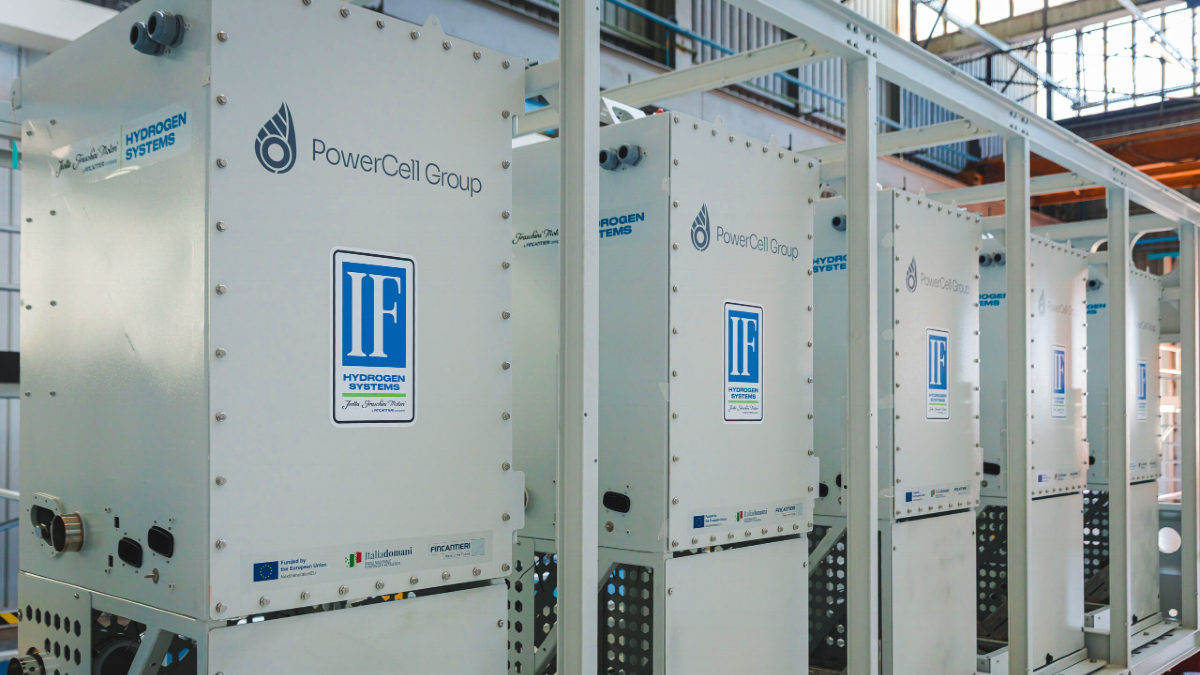
Viking Libra’s propulsion system will be based partially on liquefied hydrogen and proton exchange membrane (PEM) fuel cells. The fuel cell technology was developed by Isotta Fraschini Motori (IFM), a subsidiary of Fincantieri. The ship’s propulsion system can produce 6 MW of power.
In July 2025, IFM inaugurated a new production line at its Bari, Italy, facility, dedicated to developing and testing hydrogen fuel cell systems. Viking Libra represents one of the first marinised applications of IFM’s PEM fuel cell technology. The ship will have hydrogen stored on board, used both for propulsion and electricity generation.
IFM chief executive Andrea Bochicchio said the project “represents not only a technological advancement, but also a concrete step toward a cleaner and more efficient future.”
According to details revealed by Fincantieri at Seatrade Cruise Global 2025, the auxiliary power generation system based on PEM fuel cells powered by hydrogen will allow for zero-emissions operations in port and in the most environmentally sensitive areas. The system includes two removable tanks of liquefied hydrogen (LH2) that feed two PEM fuel cell containers, supported by a battery system designed to manage load fluctuations through peak shaving to reduce power demand during peak load conditions to cut energy costs and enhance system stability. The electrical power of the PEM fuel cells will be 6.3 MW (2 x 3.15 MW), and the battery capacity will be 4.7 MWh.
This operational profile will allow a zero-emissions mode to be used in protected areas, such as the Norwegian Heritage Fjords, and will include 3 hours of navigation at 10 knots and 10 hours in port. The annual reduction in emissions will be approximately 20% compared with a ship using fossil fuels, assuming LH2 refuelling every two days. The adoption of removable LH2 tanks, which can be easily transported by truck, allows for the immediate effectiveness of the system, even in the absence of a consolidated logistics chain for hydrogen provision in the main cruise ports.
Viking Cruises’ subsequent ocean ship, Viking Astrea, which is also under construction and scheduled for delivery in 2027, will also be hydrogen-powered and capable of operating with zero emissions.
Riviera’s Maritime Hybrid, Electric & Hydrogen Fuel Cells Conference & Exhibition will be held in Bergen, Norway, on 21-23 October 2026. Use this link for more information and to register for the event.
Related to this Story
Events

Maritime Regulations Webinar Week
 16 Dec 2025
 GMT - ONLINE
Floating energy: successfully unlocking stranded gas using FLNGs and FSRUs
24 Feb 2026GMT - ONLINE
© 2026 Riviera Maritime Media Ltd.


