


Business Sectors
Business Sectors
Events
Contents
Register to read more articles.
Applying AI to radio communications for better ship handling
Automatic speech recognition would improve VHF radio communications between pilot, tug master and ship captain, reducing incident risks in ports


Artificial intelligence (AI)-supported automatic speech recognition (ASR) could be used on ships to improve voice communications over very high frequency (VHF) radio.
Its use would enable better communications between ships, port and vessel traffic authorities, and shore services.
ASR improves the quality of voice communications and can transcribe radio communications to document conversations over VHF.
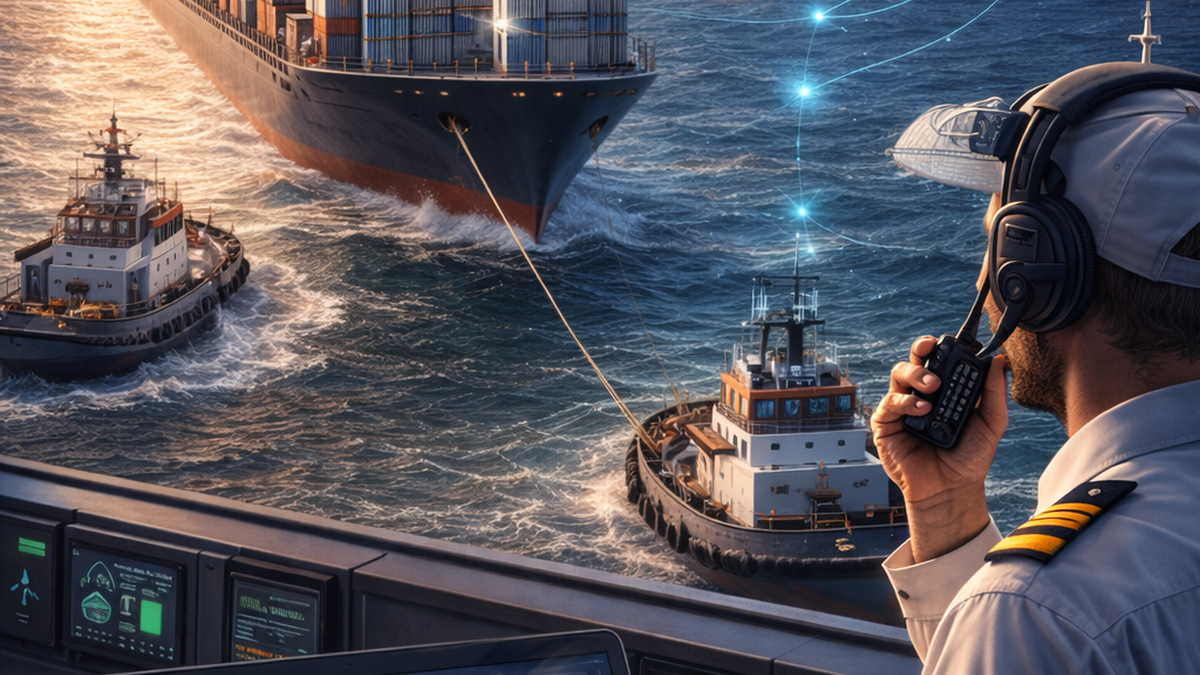
During ship handling and towage, ASR can also enhance communications between the ship captain or pilot and tug masters by translating communications into local languages, said independent maritime pilot, Mustafa Sokukcu.
“When tugboats are manoeuvring ships, generally, communications between the pilot and the tugboat crews are conducted in the local language,” he said.
“However, the ship captain, who is primarily legally responsible for ship safety, should understand all these commands or have them translated by the pilot, which is not frequently done.
“By applying ASR, voice communications between the pilot and the tugboat in the local language can be instantly translated into English and displayed in written form on a screen for the ship captain using the translation feature on a tablet or smartphone.”
Developments in ASR technology could also enable real-time translation of voice communications into different languages for the pilot, tug master or ship captain.
“Communications during remote maritime pilotage would be conducted via VHF radio”
Capt Sokukcu said hardware modifications are needed to VHF radio sets installed on the tugboats and ships to enable this future functionality.
“By taking advantage of the translation capabilities of multilingual ASR models, communications between maritime pilots and tugboat crews can be conducted in English, the internationally common maritime language, instead of the local language,” he said.
“This would enable the pilot and tugboat master’s communications to be understood by the ship’s crew without the need for verbal translation.”
ASR would also support remote pilotage, where a marine pilot with knowledge of the port could support ships sailing into harbours and docking at terminals from a shore base.

Remote guidance to the ship’s captain would reduce the risk of harm coming from pilots during their transfer between the ship and a dedicated harbour vessel, which has resulted in fatal accidents in past years.
“When considering remote maritime pilotage operations, ensuring reliable and uninterrupted communications between the pilot on shore and the ship’s crew becomes even more crucial,” said Capt Sokukcu.
“This is because communications during remote maritime pilotage would be conducted via VHF radio.”
Issues with VHF radio communications include interference coming from background noise, such as the sound of the ship’s engines running, alarms and alerts from the ship’s navigation equipment and other conversations on the bridge.
“Voice messages transmitted during communication may come through the device’s loudspeaker with crackling, muffled sound and interference,” said Capt Sokukcu.
“Communication risks can arise from misinterpreted commands given by the pilot to the ship’s crew, leading to different commands being applied.”
Using ASR would reduce these risks by providing clearer communications, translated and transcribed commands, and result in more effective teamwork.
“The aim is to use the improved software in maritime pilotage, displaying voice VHF messages in a written form on a screen in real-time with high accuracy, and to manage communication-related risks,” said Capt Sokukcu.
He has tested ASR software on VHF radio communications and intends to publish the findings from these studies in H2 2026 in an academic thesis, outlining how the data was collected, which software tools were used, how the system was tested and its success rate.
The 28th International Tug & Salvage Convention, Exhibition & Awards will be held in Gothenburg, Sweden, in association with Caterpillar, 19-21 May 2026. Use this link for more details of this industry event and the associated social and networking opportunities.
Related to this Story


Events

Maritime Regulations Webinar Week
 16 Dec 2025
 GMT - ONLINE
Floating energy: successfully unlocking stranded gas using FLNGs and FSRUs
24 Feb 2026GMT - ONLINE
© 2026 Riviera Maritime Media Ltd.


