


Business Sectors
Business Sectors
Events
Contents

Register to read more articles.
Fuel economiser promises better savings and easier CII calculations
A new fuel monitoring system for vessels has launched offering data collection services to help cut emissions by up to 20% while reducing the complexity of CII calculations


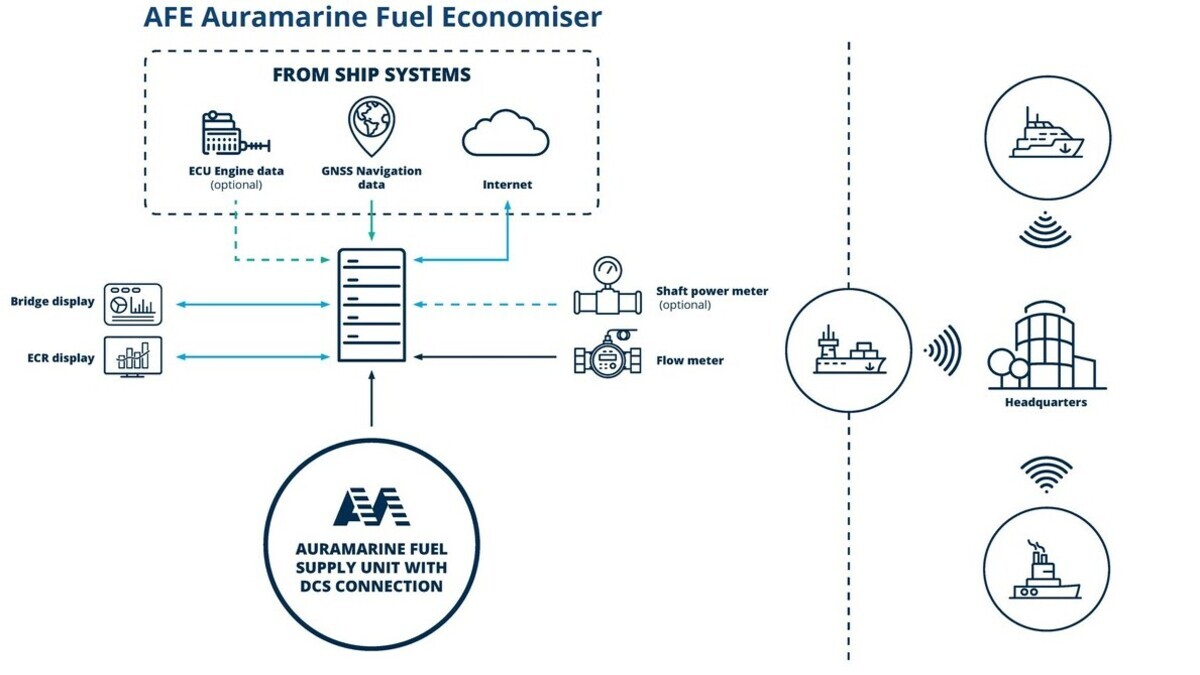
Finnish fuel supply systems provider Auramarine launched its Auramarine Fuel Economiser (AFE), targeting ship owners and operators by pitching AFE as a proactive system that analyses and identifies where fuel consumption and emissions can be reduced by monitoring fuel consumption across the entire fleet.
Better data will also make for more accurate reporting purposes in line with environmental regulations such as IMO’s Carbon Intensity Indicator (CII), according to the company, while improving fuel economy and onboard processes.
AFE collects data from fuel and power-related systems on board, ranging from main and auxiliary engines to gas turbines, boilers, and inert gas generators, monitoring systems when a vessel is in operation and when idle. A range of data is collected including fuel oil used, consumption, volume, mass information, viscosity and temperature behaviour, as well as shaft power meter and engine data.
The service highlights opportunities to reduce fuel consumption; optimising operations by analysing fuel profiles and fleet utilisation; identifying areas for enhancing safety as well as professional development; preventing unnecessary wear; and analysing Auramarine’s onboard equipment data for planned and preventative maintenance.
Auramarine CEO John Bergman said, “We understand that it is incredibly challenging for ship owners and operators to manage the process of compliance in relation to new regulations, such as CII and EEXI, while also looking at immediate and long-term mitigation strategies to reduce their carbon footprint, as well as focusing on their day-to-day operations.”
“However, while ensuring compliance can be a challenge, it also presents the opportunity to implement technical and operational solutions to maximise vessel performance. And in doing this reducing fuel consumption, and associated costs and emissions, as well as harnessing data in a consistent, and reliable way that provides actionable insights that are required for reporting but also enable the very best decision-making that improves operational efficiencies.”
Under the CII regulation, shipowners of vessels 5,000 GT and heavier are required to collect and report data that measures a vessel’s annual operational carbon intensity.
That data feeds into a rating system - the CII rating - that ranks vessels in alphabetical bands from A through E, with A being the highest rating for the vessels with the lowest carbon intensity in their operations. Vessels that fall into the bottom two categories, D and E, are required to make remedial efforts to lower their carbon intensity.
Ships rated D for three consecutive years and ships rated E for one year will be required to submit their "corrective action plans" to regulators.
Thresholds will also become increasingly stringent through 2030, including from other regulatory bodies such as the European Union which is set to include shipping in its own emissions trading scheme.
Riviera Maritime Media’s Maritime Decarbonization Conference, Americas will be held 12-13 December 2023 in Houston, USA. Use this link for further information and to register your interest





Events

Maritime Regulations Webinar Week
 16 Dec 2025
 GMT - ONLINE
Floating energy: successfully unlocking stranded gas using FLNGs and FSRUs
24 Feb 2026GMT - ONLINE
© 2026 Riviera Maritime Media Ltd.


