


Business Sectors
Business Sectors
Events
Contents
Register to read more articles.
Red Funnel moves forward with e-foiling ferry
The UK ferry operator opens up on demonstrating the technology to be used in its new Artemis EF-24 Passenger ferry


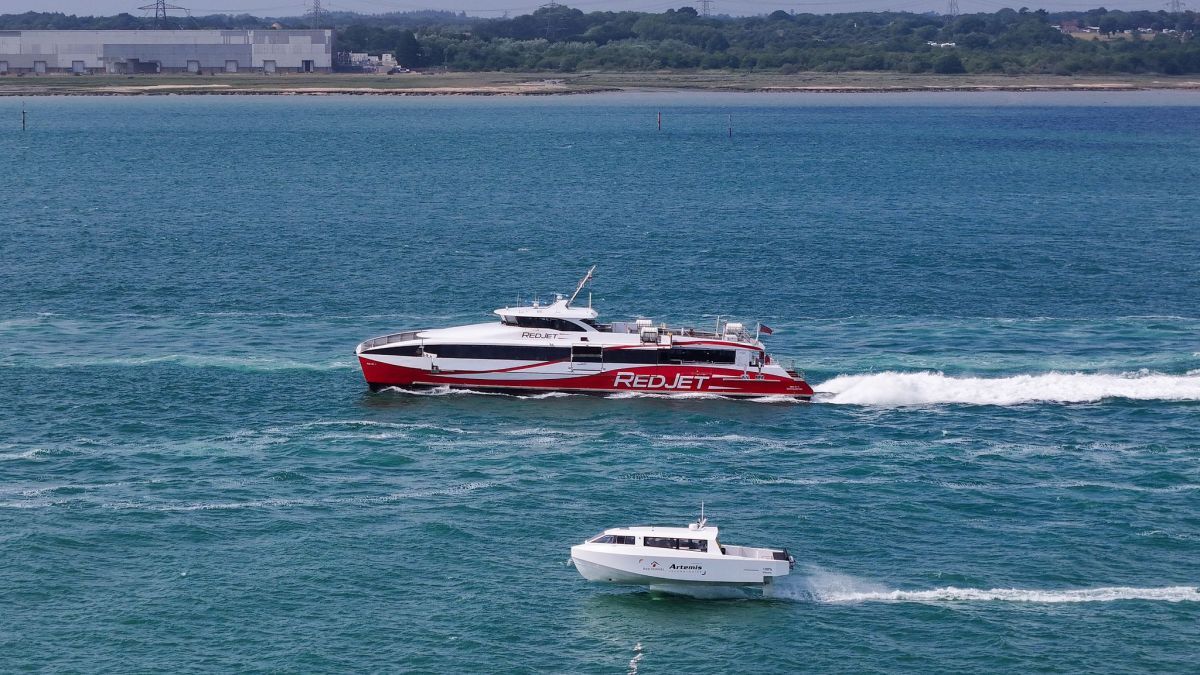
Red Funnel, in partnership with Artemis Technologies, has opened a new chapter in sustainable ferry travel with a successful demonstration of the technology underpinning the Artemis EF-24 Passenger ferry at the Royal Yacht Squadron in Cowes.
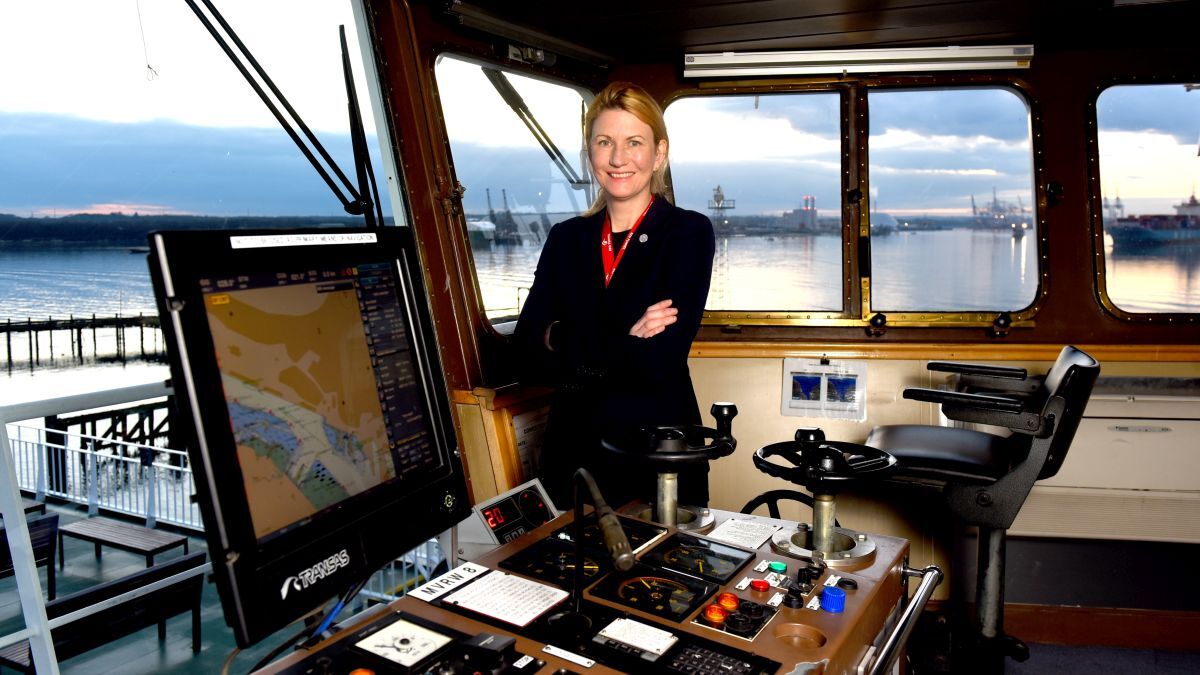
Hosted by Red Funnel chief executive Fran Collins and Artemis Technologies chief executive Iain Percy OBE, the shoreside event welcomed more than 75 guests, industry leaders and Island representatives aboard the 12-m demonstration vessel, offering guests the opportunity to experience the same clean maritime technology which will power the Artemis EF-24 Passenger ferry. The 100% electric Artemis EF-24 Passenger will join Red Funnel’s high-speed fleet in 2026.
The Artemis EF-24 Passenger ferry is designed to carry up to 150 passengers, creating zero emissions in operation. Using advanced hydrofoil propulsion to lift its hull clear of the waves, it significantly reduces drag and wake. Once in service, it is expected to save up to 3,700 tonnes of CO2e each year compared with conventional high-speed ferries – eliminating local emissions while offering a quieter, smoother ride.
Ms Collins says, “This moment has been a long time in the making. Six years ago, we made a bold commitment to a cleaner, greener future, and today, we were thrilled to share a glimpse of that future with so many guests.
“Our partnership with Artemis Technologies marks a pioneering step forward, not just for Red Funnel but for sustainable maritime transport across the Solent. This isn’t just a new vessel; it’s the beginning of a new era – defined by zero-emissions technology, a smoother passenger experience, and a shared ambition to decarbonise ferry travel. The road ahead will bring learning and challenges, but that’s what it means to be brave, to innovate, and to lead. Together with Artemis, we’re proud to be doing something truly different.”
Dr Percy commented, “We have combined cutting-edge design with advanced hydrofoil technology to create a vessel that not only reduces emissions but also enhances performance and comfort. Together, we are establishing a new benchmark towards a more responsible and resilient maritime industry.”
Ms Collins recalls how the journey to work with Artemis started 18 months ago with an invite from Dr Percy to see the technology in person in Belfast.
“I was blown away by the technology and work and research into this and it became feasible and viable. We are here with something real and tangible. In the next 12 months we will have our vessel on the water.”
Speaking to PST about the effect on the fleet, she says, “The impact is huge. In some ways it’s underwhelming and others hugely overwhelming. This is because the technology is working and doing as it should, but at the same time the customer experience is better, smoother and quieter, both for those on board and in the vicinity.”
She singles out the partnership aspect with Artemis as being crucial. A major issue, she says, is the amount of risk the company would have to put into a lifeline service by using new technology.
But this risk has been taken away because the UK operator is working in a partnership with Artemis. Ms Collins comments, “We have very open and frank discussions about the design, about the constraints we have as operators, and Artemis has as builders, and it has meant we can introduce it among the current fleet. We will bring the vessel into service and gradually replace a Red Jet service, but we will keep the Red Jet and that’s over a three-year partnership.”
This ties into the capex and opex. “This goes back into the partnership, and bringing in the Red Jet, it means we are doing this on a no-risk basis, so it is commercially viable.”
She points out the capex is more expensive because of the technology used and the fact that batteries are deployed, but from an opex standpoint, they require less downtime, with fewer moving parts and less maintenance. “So it’s an interesting pay off.”
Key to the new vessel is the huge amounts of data that will be collected by Artemis. Ms Collins says, “The data is phenomenal, it captures everything. Artemis has taken that from the culture of yacht racing and deployed it here. In the trials carried out over the last few days, the captured data, the tuning and the trim, is amazing. This will fine tune the vessel, how it is trimmed, how the foils are flexed, even down to the design, so some pieces around the foil design, we will trim that.”
After Red Funnel has deployed the ferry for three years, it will receive its second Artemis vessel via a formal agreement [assuming the first vessel meets its metrics], which it is expected to.
“This gives us time to refine the design.” Asked if the configuration could be different to the first one, she says, “It could be different, whether the configuration will be the same, we will know more how it fits into our fleet [after the three years].”
As well as the vessel, Artemis will also provide the shore power infrastructure. “It has not been too much of a challenge,” comments Ms Collins. “We are going to have a triple charge into the battery storage facility, so when the vessel comes in, we will have a fast dump charge through the day as part of its turnaround and then a bigger charge overnight. It draws 0.3 MW, so is less of a challenge. We might have to upgrade our landside infrastructure (sub stations) for the second vessel coming in.”
But it will be a different story for Red Funnel’s larger ropax fleet. Ms Collins explains, “Our vehicle ferries are towards their end of life, and we have designs ready to send to shipyards. They can’t be fully electric because we do not have the power supply on the mainland grid infrastructure, even though it is feasible, we need 8 MW to recharge them, so we can build them fully electric but without the charge they will be hybrid.”
Therefore, the company will build them as diesel electric, and they will be designed to be retrofitted. “This means when we eventually have a good power supply at the port, we can go for hydrogen fuel cells or another fuel.”
Asked about the type of fuel the company will choose, she underlines, “We are looking, but we need to be careful because we offer a lifeline service and that is the beauty of the Artemis technology, we are at the bleeding edge of technology which is proven in the smaller designs and doing it in a way in which we can maintain the lifeline service.”
Meanwhile, for Artemis’ Dr Percy, this contract has special significance. He grew up in Southampton. “I always used to come out here [Isle of Wight] on the Red Jet, so have an amazing affinity. I’m so proud to bring the iconic e-foiler here,” he recalls.
The seeds of Artemis Technologies started growing six years ago, when Dr Percy started out with a mission to decarbonise maritime. He explains, “I started a company with a mission but not a product. I set off with the idea of zero-emissions technology that was economically viable… right from the outset we ended up with a solution to save enough energy to justify the costs of the technology.”
As well as zero emissions, big passenger benefits include the smoothness and comfort of the ride.
“We needed early adopters - companies willing to introduce new technology so we are thankful to Red Funnel. Having early adopters is so important as although the economics work well, it is new and others think ‘do we want to take the risk?’ and it’s those testimonials [from early adopters] that make people realise they can make the jump as well.”
The Artemis vessels all have similar centres of gravity and the hulls are the same, but they are customised to meet operators’ needs when it comes to boarding and unboarding and layout. He points out, “There are small differences but one of the things required with new technology is more modularity and consistency than other boats.”
Data is integral to the solution. Dr Percy says, “On our vessels, we collect data continuously to improve ride comfort and flow characteristics. We check for issues and validate the business case: this is how much energy is being used, we provide comfort metrics and we measure accelerations and emissions. You can put a number on them that others can take comfort from and adopt, and it is also useful for us to improve.
“Red Funnel will know all the data, they will be aware of the emissions they are saving, the fuel they are using. The idea of remote monitoring is common but the difference for us is we have a different type of solution, and the data shows the difference it makes.”
Dr Percy says the Artemis technology is developing every day. “The control side is always improving, there will be next-generation batteries and drive trains and different manufacturing methods around carbon fibre… we are proud we offer an attractive business case but there is still more we can do, we can drive down costs, we can increase efficiency and improve ride comfort.”
Artemis’ e-foiling solution can bypass shore power issues. “By using much less power, we need much less power from the grid, this is fundamental to the whole viability. Less power needed from the grid means almost the biggest barrier removed. But even so, the ferry will not recharge fast enough from the grid, so we use a battery buffer filled up continually from the speed of the grid. Then from battery to boat, the charge is much faster. We developed the MW marine-approved battery system to do that. It’s an important way the charging side does not make our vessels uncompetitive. We had to find a solution to make them a viable solution which is why we have gone into charging too.”
Next steps include crew training using Artemis Technologies’ simulator for Red Funnel’s high-speed team. Naming the vessel will be the next milestone, and Red Funnel will be reaching out to customers and local residents to be part of this process.
Sign up for Riviera’s series of technical and operational webinars and conferences:
- Register to attend by visiting our events page.
- Watch recordings from all of our webinars in the webinar library.
Related to this Story
Events

Maritime Regulations Webinar Week
 16 Dec 2025
 GMT - ONLINE
Floating energy: successfully unlocking stranded gas using FLNGs and FSRUs
24 Feb 2026GMT - ONLINE
© 2026 Riviera Maritime Media Ltd.


