


Business Sectors
Business Sectors
Events
Contents

Register to read more articles.

How e-turbocharging rises to the call for instant power in marine operations
Electrically assisted turbocharging provides additional boost when exhaust energy is insufficient and effectively eliminates turbo lag


Among the sustainable fuels under development, Rolls-Royce Power Systems ((RRPS) identifies e-methanol as one of the most promising for marine propulsion. Produced from renewable energy sources, e-methanol, also known as ‘green’ methano, enables CO2-neutral operation while significantly reducing harmful emissions such as nitrogen oxides and particulates. Compared with other sustainable fuels, e-methanol also offers a relatively high energy density, making it especially attractive for shipping applications.
Through the publicly funded meOHmare project, RRPS developed what it calls the ‘world’s first spark-ignited methanol engine in the 2,000-kW class’, based on the 16V4000 platform. This pioneering engine demonstrates that high power output and sustainable operation can coexist.
Parallel to this, the company is continuing single-cylinder test-bench trials to develop a dual-fuel combustion process in which methanol is ignited by a small pilot diesel injection. This bridging technology will allow significant CO2 savings, even before methanol is available in sufficient quantities to run engines exclusively on the renewable fuel.
“Future turbocharger development will focus on increasing efficiency”
RRPS’s perspective is that true decarbonisation is not just about cleaner fuels but holistic system integration. Every component, from fuel injection to turbocharging, must operate in harmony to maximise efficiency.
A prime example is the new 12-cylinder mtu Series 2000M96Z engine for yachts and fast vessels. Delivering 1,634 kW, it offers an 11% increase in power over the previous 12V 2000M96X, while maintaining virtually identical dimensions. The achievement stems from improved turbocharger performance, enhanced crankcase and cylinder head design, and newly developed pistons. The engine is approved for operation with sustainable hydrogenated vegetable oil, known also as HVO fuel, and meets IMO II and EPA Tier 3 recreational certifications.
“Future turbocharger development will focus on increasing efficiency through advanced materials, improved aerodynamics, and optimised bearing systems to reduce friction and thermal losses,” explained RRPS vie president, fluid systems design, Kapil Verma.
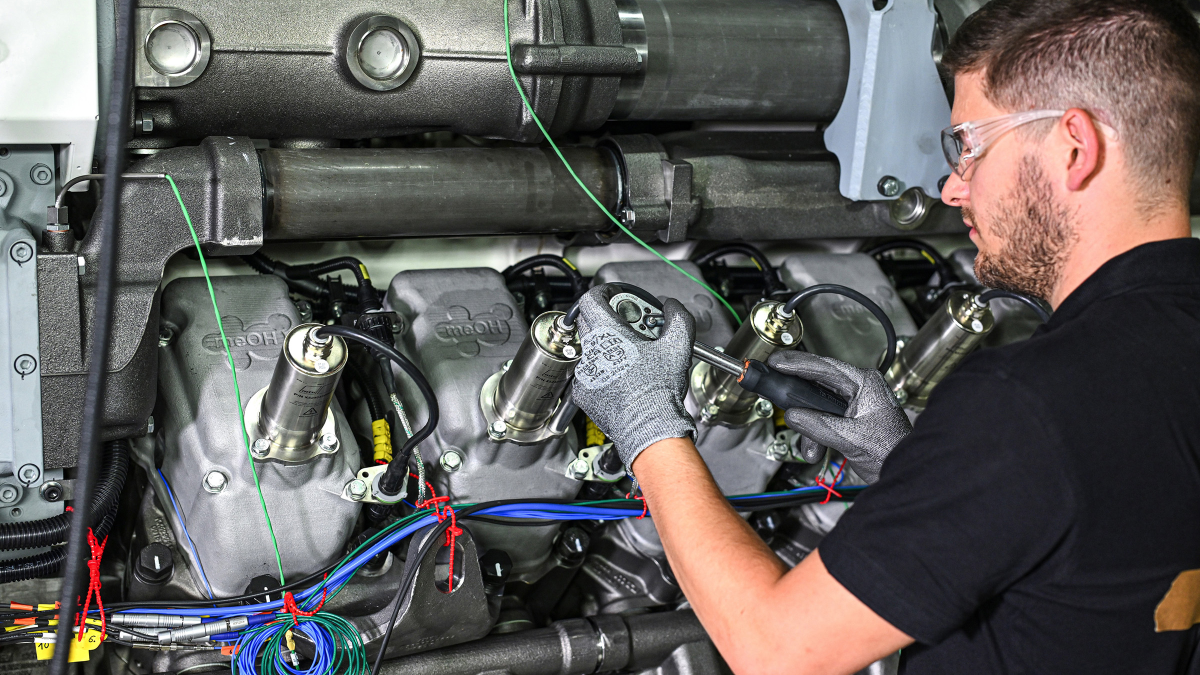
E-turbocharging
One of the most significant advancements in propulsion efficiency is electrically assisted turbocharging, or E-turbo technology. These hybrid systems integrate an electric motor-generator on the turbo shaft, providing additional boost when exhaust energy is insufficient and effectively eliminating turbo lag.
“Rolls-Royce Power Systems has achieved a major milestone with the electrically assisted turbocharger ZR3e, capable of use on 12V4000 gas engines,” said Mr Verma. “Initial component tests show faster charge-air build-up due to acceleration of the turbocharger shaft with electrical boost,” he said.
E-turbos are ideal for applications demanding instant power, such as military vessels, high-performance yachts, and standby power generation. Field introductions across marine and power-generation sectors are expected soon. By supplying boost at low engine loads, E-turbos can cut fuel consumption by five to 10% and reduce emissions without compromising responsiveness. At higher loads, they recover excess exhaust energy and convert it into electrical power to charge onboard batteries or support hotel loads, aligning perfectly with hybrid propulsion architectures.
“E-turbos can cut fuel consumption by five to 10% and reduce emissions”
Market data reflect this momentum: the global hybrid turbocharger sector is projected to grow by over 4% annually through to 2035, driven by stricter emissions regulations and the demand for improved transient performance.
The company is also developing a highly compact two-stage turbocharging system for marine applications. Air flows axially onto the turbines, enabling a more compact design that reduces thermal losses and improves engine-turbo matching. The result is superior part-load performance, lower fuel consumption, and simplified servicing.
The system’s modularity ensures that future turbo modules can be rapidly adapted to evolving fuel types and emissions standards, an important advantage as ship operators prepare for variable-fuel fleets.
To further boost efficiency and durability, the company’s engineers are exploring advanced materials and additive manufacturing techniques. Across the industry, turbochargers increasingly employ ceramic-matrix composites, thermal-barrier coatings, and 3D-printed turbine components. These innovations allow higher turbine inlet temperatures, lower thermal losses, and greater resilience, especially vital when operating with synthetic or renewable fuels that alter combustion temperatures and exhaust chemistry.
Additive manufacturing also enables intricate cooling channels, optimised blade geometry, and stronger yet lighter casings. This design freedom allows smaller, more efficient turbo units, while maintaining reliability.
Extending TBOs
As propulsion systems become smarter, turbochargers are following suit. RRPS integrates its turbochargers into digital twin platforms and condition-based maintenance (CBM) systems, using sensor networks to monitor temperature, vibration, shaft speed, and pressure in real time.
These insights support predictive analytics that identify early signs of wear and schedule maintenance before failures occur. Turbochargers are now designed with extended time between overhauls (TBO), aligned with engine lifecycles. Each new unit undergoes rigorous analytical optimisation in thermodynamics, structural mechanics, and containment strength before physical testing.
Such digital intelligence not only extends service intervals and reduces downtime, but also ensures that decarbonisation goals are not compromised by mechanical inefficiencies. Future systems are expected to feature self-optimising turbochargers capable of dynamically adjusting vane geometry, bypass ratios, or electric assist input, based on live operating data.
Tomorrow’s turbochargers will increasingly reclaim exhaust energy through turbo-compounding and waste-heat recovery. These concepts employ additional turbines downstream of the main turbocharger to power generators or auxiliary systems. Although RRPS has yet to commercialise a turbo-compounded marine engine, such systems are well suited to hybrid vessels, where recovered energy can recharge batteries or support onboard systems. In the long term, these designs could deliver total efficiency gains of eight to 12%.
Patent filings and academic studies reveal further developments, including the integration of electric motor-generators directly onto turbo shafts to enable bidirectional energy flow. Such innovations, validated in testbeds, are now approaching commercial readiness.
Research suggests that hybrid turbochargers can enhance brake thermal efficiency in natural-gas marine engines by improving transient response. Electrically assisted and hybrid turbocharging are therefore not futuristic concepts but imminent engineering realities.
Despite rapid progress, challenges remain. Engineers must ensure material durability under hydrogen and ammonia combustion, manage thermal cycling and efficiency in hybrid configurations, and meet evolving class and regulatory standards.
Yet, these same challenges are driving innovation. Hybridisation, while complex, opens new opportunities for energy recovery, cleaner operation, and predictive control.
By the mid-2030s, mtu turbochargers may function less as static air pumps and more as intelligent hybrid energy managers, optimising airflow, recycling exhaust power, and communicating directly with onboard control systems. The next generation will likely feature full electric assist with regenerative capability, adaptive geometry for multiple fuels and ambient conditions, and real-time digital optimisation.





Related to this Story



Events

Maritime Regulations Webinar Week
 16 Dec 2025
 GMT - ONLINE

Floating energy: successfully unlocking stranded gas using FLNGs and FSRUs
24 Feb 2026GMT - ONLINE
© 2026 Riviera Maritime Media Ltd.


