


Business Sectors
Business Sectors
Events
Contents

Register to read more articles.
New turbocharger developed for two-stroke hydrogen dual-fuel marine engine
MHI-MME will supply an axial turbocharger for the J-ENG low-speed engine targeted for hydrogen-powered multi-purpose shipping


One of the first hydrogen dual-fuel two-stroke, low-speed marine engines developed in Asia will have turbocharger technology developed by Mitsubishi Heavy Industries Marine Machinery and Equipment Co (MHI-MME).
According to MHI-MME, the MET33MB exhaust gas turbocharger is meant for Japan Engine Corp’s 6UEC35LSGH marine engine, which is rated at 5,610 kW at 167 rpm. The engine will be completed in 2027 and installed in a Mitsui OSK Lines’ hydrogen-fuelled multi-purpose vessel built by Japan’s Onomichi Dockyard. Plans call for the 17,500-dwt vessel to begin demonstration operations for MOL Drybulk in 2028.
ClassNK granted an approval in principle for the vessel’s design in 2023. A concept image shows the hydrogen fuel tank installed aft of the vessel’s bridge and superstructure.
“We are stepping up decarbonisation efforts”
This newest turbocharger to support hydrogen as a fuel is part of MHI-MME’s ongoing efforts to underpin the evolution of new marine engines designed to reduce greenhouse gas (GHG) emissions.
“We are stepping up decarbonisation efforts, such as engaging in multiple next-generation fuel technology development projects and working to become a leading supplier of turbochargers for dual-fuel engines, designed for the combustion of alternative fuels, such as methanol and ammonia,” said company president and chief executive, Katsuhide Matsunaga.
MHI-MME’s MET-MB series axial turbochargers are applicable to two-stroke engines designed by Everllence, WinGD and Japan Engine Corp (J-ENG), all of which have developed alternative fuel-capable dual-fuel engines.
Engine demonstration
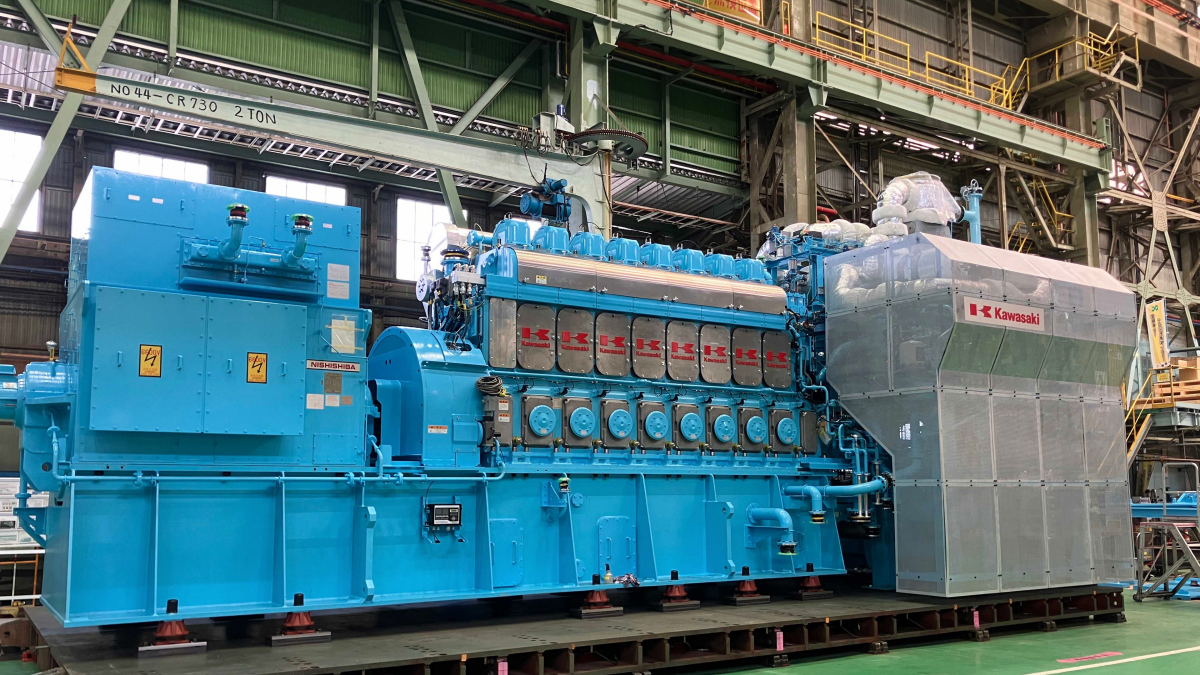
In late October, the Japanese tripartite of Kawasaki Heavy Industries (KHI), Yanmar Power Solutions and J-ENG reported the successful demonstration of what they described as “the world’s first land-based operation of marine hydrogen engines.” The demonstration, held at J-ENG’s factory near Kobe, used a newly developed KHI liquefied hydrogen fuel supply system (HFSS) in connection with a Yanmar Power Solutions medium-speed, four-stroke hydrogen dual-fuel engine. The two Japanese engine designers reported the tests showed stable operation of the 6EY22ALDF-H medium-speed hydrogen dual-fuel engine, which has a rated output of 900 kW at 800 rpm. The parties plan further development to refine the engine’s performance.
The KHI-manufactured liquefied HFSS stores and gasifies liquid hydrogen, supplying it at both high and low pressure to engines developed by KHI, Yanmar and J-ENG. As a result, testing can be conducted across a range of applications, including low-speed, two-stroke main propulsion engines, four-stroke auxiliary engines and four-stroke main generator engines for electric propulsion ships.
KHI has also developed an 8L30KG-HDF medium-speed, four-stroke hydrogen dual-fuel engine, rated at 2,600 kW at 720 rpm.
If fuelled with green hydrogen, all three engines developed by the Japanese partners will significantly reduce GHG emissions. The engine platforms will also provide redundancy and fuel flexibility through a dual-fuel system that can switch between hydrogen and diesel fuel as required.
The demonstration project conducted by KHI, Yanmar and J-ENG is a part of Green Innovation Fund Projects’ “Next-Generation Ship Development” of Japan’s New Energy and Industrial Technology Development Organization (NEDO), commissioned under the “Development of Marine Hydrogen Engine and Marine Hydrogen Fuel System.”
It is just one of many projects being funded by Japan to advance its ambition of carbon neutrality by 2050.





Related to this Story


Events

Maritime Regulations Webinar Week
 16 Dec 2025
 GMT - ONLINE

Floating energy: successfully unlocking stranded gas using FLNGs and FSRUs
24 Feb 2026GMT - ONLINE
© 2026 Riviera Maritime Media Ltd.


