


Business Sectors
Events
Contents

Powerful simulation plots the best course to electrification
ABS vice president, Technology (Pacific), Gu Hai, details how the class society is using simulation to mitigate risk for new technologies and cargo


Zero-emissions coastal and harbour zones, shore-power requirements, emissions regulations and improvements in battery systems have owners thinking about incorporating electrification technologies into their ships.
One of the trends noted by ABS vice president, Technology (Pacific), Gu Hai, is an increase in owners considering retrofits and hybrid solutions. Some owners, for example, are considering refitting their ships with shaft generators and batteries. “But shaft generators are not always the best solution for every vessel,” he said. “It depends on the vessel type, its existing systems, and its operational profile. We can use simulation to help owners with these assessments,” he said.
“Once you build a detailed model of the ship propulsion and power generation system, you can try several different scenarios to see which combination of equipment makes sense for the specific vessel. It’s a powerful tool,” he said.
“We are using simulation to support the evaluation of different concepts from safety and performance perspectives. Most of the work covers either fully electric vessels or hybrid solutions for ships. Whether it is a newbuild or retrofit concept, we are aiming to develop a systematic quantitative method for assessing different technologies or systems related to electrification,” he said.
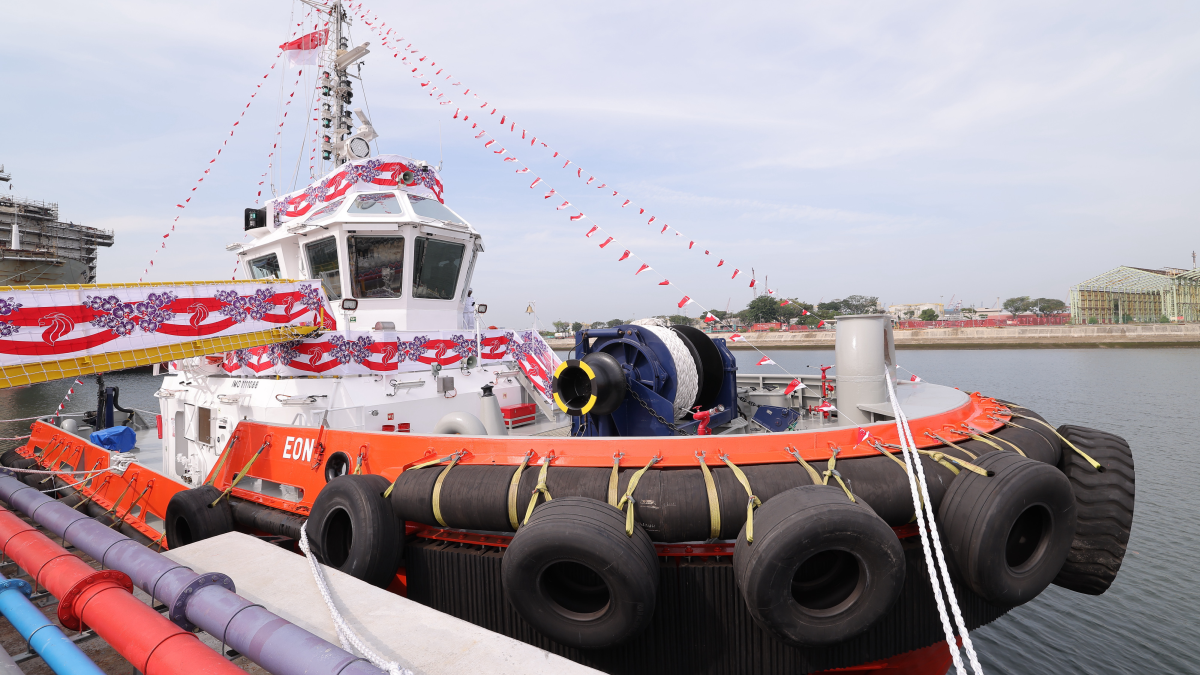
ABS is working on several maritime electrification projects in Singapore. The Maritime and Port Authority of Singapore wants harbour craft operating in the port to be fully electric, capable of using B100 biofuel, or compatible with net-zero fuels such as hydrogen by 2030.
Mitigating fire risks
Speaking at the ABS office in Singapore, Gu Hai pointed out that ABS is using advanced simulation modelling to investigate lithium-ion battery fires caused by electric vehicles (EV) carried on car carriers and roros. The research is being carried out in the wake of several recent catastrophic car carrier fires.
“We are trying to develop a systematic approach to evaluating the risk to the ship if different mitigation measures are taken for the cargo,” he said. “How do I evaluate the risk quantitatively with different measures? Fire on a car carrier is an infrequent event that can result in significant damages. In this case, a conventional deterministic simulation method will not suffice, and a probabilistic simulation approach that considers the risk profiles of the elements across the multi-level system is needed. This is an on-going work and I hope to share more about it once the preliminary results can be made public.”
To gain insight, ABS has reached out to partners across the industry, including vessel owners, charterers, ship designers, shipyards, P&I Clubs, and marine insurers. “Fire safety onboard roros carrying electric vehicles is one of those top-of-mind topics for everyone in the vehicle shipping industry. There is significant momentum for collaboration across the value chain to address this risk,” he said.
ABS offers both an enhanced fire protection notation EFP-C(EV) in the ABS Marine Vessel Rules, which provides criteria for additional fire protection arrangements in roros carrying EVs, as well as the advisory Best Practices for the Transport of Electric Vehicles Advisory. The class society is also funding advanced research.
“Different technologies are available that can potentially reduce the risk of fire,” he said. But owners and charters need to see a clear value for them before committing to the investments. “We hope our simulation-backed quantitative risk assessment method will be able to provide a helpful reference for the stakeholders to make informed fleet upgrade decisions.”
Related to this Story

Events

Maritime Regulations Webinar Week
 16 Dec 2025
 GMT - ONLINE
Floating energy: successfully unlocking stranded gas using FLNGs and FSRUs
24 Feb 2026GMT - ONLINE
© 2024 Riviera Maritime Media Ltd.


