


Business Sectors
Business Sectors
Events
Contents

Register to read more articles.
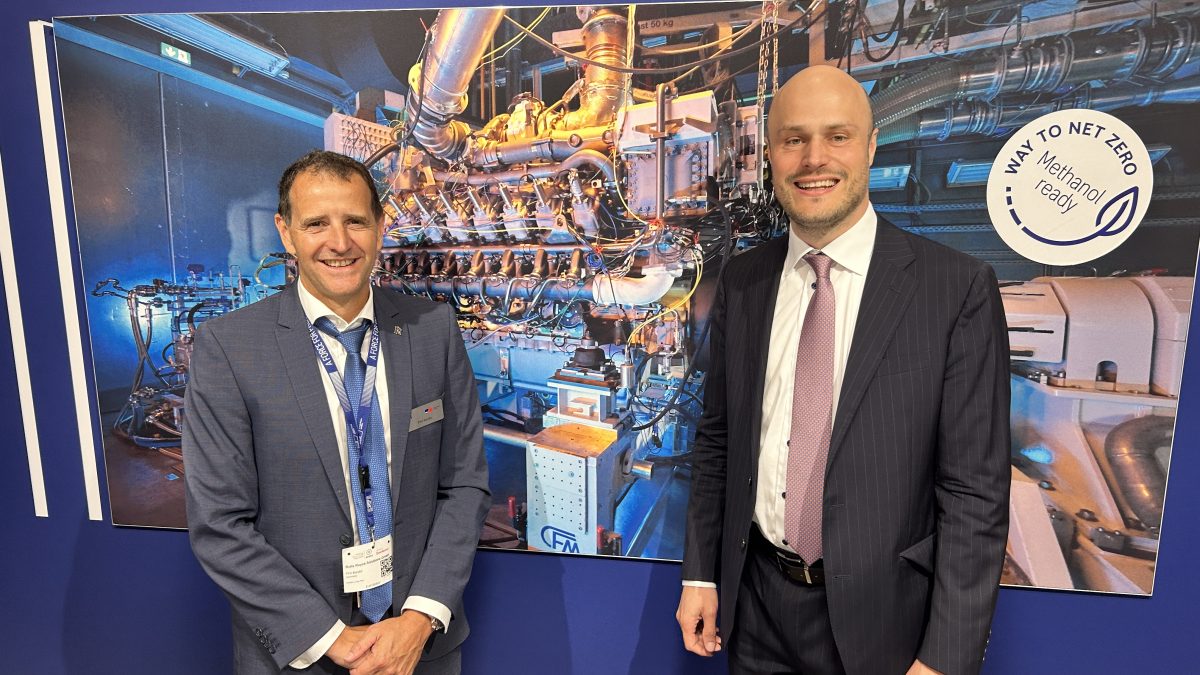
Rolls-Royce’s single-fuel methanol prototype moves towards commercial release
Rolls-Royce Solutions executives discuss their research into a methanol-only, high-speed mtu marine engine, and the expansion of their variable-speed genset portfolio


Rolls-Royce Solutions GmbH executives say they plan to bring a new single-fuel, spark-ignited methanol engine with “diesel-like performance” to the marine market within two years.
“We received a methanol-readiness certificate from DNV that basically rubber-stamps what we achieved last year with our first high-speed methanol engine prototype,” said Lukas Köhler, Rolls-Royce Solutions’ senior vice president, global marine & mining.
In 2025, Rolls-Royce completed tests on its high-speed methanol marine engine in Friedrichshafen, Germany. Since then, it has completed and analysed more than 5,000 operating hours on various test benches in single- and dual-fuel mode using methanol.
“What’s amazing about the prototype is that it shows diesel-like performance when using methanol,” he said, noting the 2-MW engine had “fantastic load acceptance.” The combustion process is optimised for methanol.
The certification of its current mtu Series 4000 engines validates the technological concept that will enable newly built Rolls-Royce marine propulsion systems to be retrofitted for dual-fuel operation with methanol in future.
“The prototype shows diesel-like performance when using methanol”
That future has become uncertain after IMO delayed adopting the Net-Zero Framework. Instead of a global regulatory framework, vessel operators face a patchwork of regional emissions regulations.
Joining Mr Köhler at SMM 2026 was the company’s senior expert in commercial marine business, Phil Kordic. Mr Kordic said a stronger regulatory push would “give everybody surety to keep moving forward at pace.” He pointed out that the enginemaker has been testing both single- and dual-fuel technology, as well as other solutions to support hybrid-electric propulsion to increase efficiency, lower fuel consumption, cut maintenance costs and slash greenhouse gas emissions.
“We firmly believe in methanol as the most relevant fuel of the future for the types of applications we support,” said Mr Kordic. But single-fuel engines need the surety of fuel supply, he said. “It’s impacting bringing forward what we see as a good solution.”
Added Mr Kordic: “A single-fuel engine on 100% methanol makes a lot of sense to us in the long term. And you don’t need an exhaust gas treatment system. You just need surety of methanol supply.”
Mr Kordic believes vessel operators with hybrid-electric and battery-powered ships will be interested in Rolls-Royce’s expanding variable-speed genset portfolio: “We are a little different from our competitors because we cover a broad power range with our Series 2000 and Series 4000 mtu engines.”
Variable-speed gensets, with an operating speed range of approximately 1,200 to 2,450 rpm depending on the engine type, and an electrical output of 650 to 1,850 kWe, can be adapted to different load profiles, making them suited for battery-powered marine applications and as range extenders.
This year, Rolls-Royce Solutions added a new variable-speed genset based on its Series 2000 mtu engines. The new gensets adjust their engine speed to match actual power demand, reducing fuel consumption and CO2 emissions during operation by up to 15% compared to fixed-speed units. At the same time, they operate about 6 dB quieter than conventional units.
Their compact design and high-power density make the generator sets suited for vessels with limited space and weight constraints, such as ferries, crew boats, OSVs, yachts, and patrol boats.
“With our new offering, we provide an industry-wide advantage by offering variable-speed generators that cover a very wide power range - we offer 8V, 10V, 12V, and 16V models. This allows us to offer our customers a generator for every project that is optimally sized and highly efficient,” concluded Mr Köhler.




Related to this Story


Events

Maritime Regulations Webinar Week
 16 Dec 2025
 GMT - ONLINE

Floating energy: successfully unlocking stranded gas using FLNGs and FSRUs
24 Feb 2026GMT - ONLINE
© 2026 Riviera Maritime Media Ltd.


